

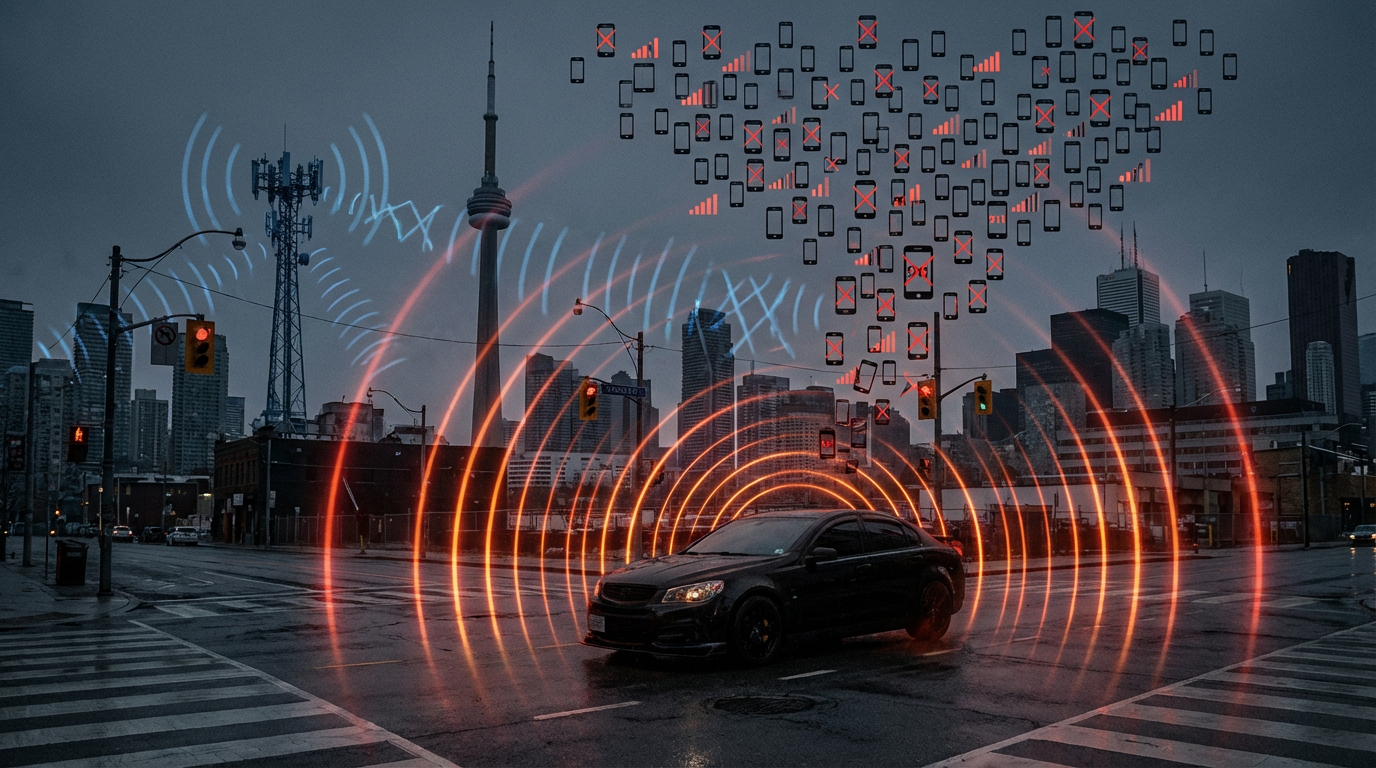

Toronto Police announced on Friday the results of Project Lighthouse, an investigation that exposed a first-of-its-kind threat in Canada.
- Toronto Police dismantle Canada's first SMS blaster ring after three men deploy mobile fake cell towers to steal banking data.
- The operation causes 13 million network disruptions across the Greater Toronto Area while sending phishing messages to hundreds of thousands of devices.
- Project Lighthouse reveals systemic cellular vulnerabilities as mobile fake towers block emergency 911 calls without detection by major Canadian telecom providers.
Three men face 44 criminal charges. Together they operated a mobile SMS blaster, a device that mimics legitimate cell towers, intercepts phone connections and sends mass fraudulent text messages.
The operation ran from late 2025 through March 2026 across the Greater Toronto Area.
The Invisible Hijack
An SMS blaster is deceptively simple. Any phone within its range that searches for a cell signal connects to it automatically. The user sees nothing.
Once connected, the device sends fraudulent texts impersonating banks, Canada Post and government agencies. Each message contains a link to a phishing website designed to steal banking credentials and personal data.
Genuine News Deserves Honest Attention.
High-conviction projects require an intelligent audience. Connect with readers who value sharp reporting.
👉 Submit Your PRWhile phones are connected to the blaster instead of legitimate towers, they cannot access real cellular service. During those windows, emergency calls may not go through.
Detective Sergeant Lindsay Riddell of the Toronto Police Service said the device “can prevent users from contacting emergency services.”
Over months of operation, police documented more than 13 million network disruptions where devices could not properly connect to legitimate cell towers, according to the Toronto Police Service official release. Hundreds of thousands of phones connected to the blaster and received fraudulent texts.
“We also identified more than 13 million network disruptions where devices were unable to properly connect to legitimate cell towers,” Toronto Police said in a statement. “In some cases, these disruptions temporarily prevented users from accessing legitimate cellular service. During those windows, people trying to call 911 may not have gotten through.”
Police have not confirmed how many of those 13 million disruptions involved active 911 attempts.
Three Arrests, 44 Charges
Police executed search warrants in Markham and Hamilton on March 31, 2026. They arrested two suspects and seized multiple SMS blasters, including the vehicle-mounted unit. A third suspect turned himself in on April 21.
The accused are Dafeng Lin, 27, of Hamilton; Junmin Shi, 25, of Markham; and Weitong Hu, 21, of Markham. All three are Chinese nationals.
They face 44 charges including fraud, mischief endangering life, unauthorized possession of credit card data, fraudulently intercepting computer systems, conspiracy to commit indictable offences, intercepting private communications and trafficking in identity information.
The Toronto Police Service provided the official announcement. Telus, which cooperated with the investigation, did not respond to requests for comment on broader network vulnerabilities. Rogers Communications and Bell Canada did not respond. Innovation, Science and Economic Development Canada did not respond by publication deadline. The Chinese Consulate in Toronto did not respond to requests for comment on whether consular access has been provided to the accused.
A $500 device and a moving car disrupted communications for potentially hundreds of thousands of people across a major metropolitan area. SMS blasters were documented in China in 2021 and appeared in Eastern Europe in 2023-2024. Their arrival in Canada in 2025 follows a pattern cybersecurity experts have observed for years. Police have not stated whether they believe the operation was directed by state actors or private criminal networks. No evidence of Chinese government involvement has been presented.
Canada has no framework mandating cell-site simulator detection. Telecoms can deploy the technology. Nothing forces them to.
Chain Street’s Take
Most coverage will focus on the phishing messages and the Chinese nationals. That’s the easy story.
The harder story is the 13 million network disruptions. Each one was a moment when the cellular network failed its most basic job. And nobody noticed until the police told them.
SMS blasters aren’t new. China saw them in 2021. Europe saw them in 2023. Canada is late to this threat.
The real question is why telecom companies haven’t deployed detection technology faster. Cell-site simulator detection exists. It’s not cheap. But neither is a lawsuit from someone whose 911 call didn’t go through.
Project Lighthouse caught three people. It did not fix the infrastructure.
Activate Intelligence Layer
Institutional-grade structural analysis for this article.