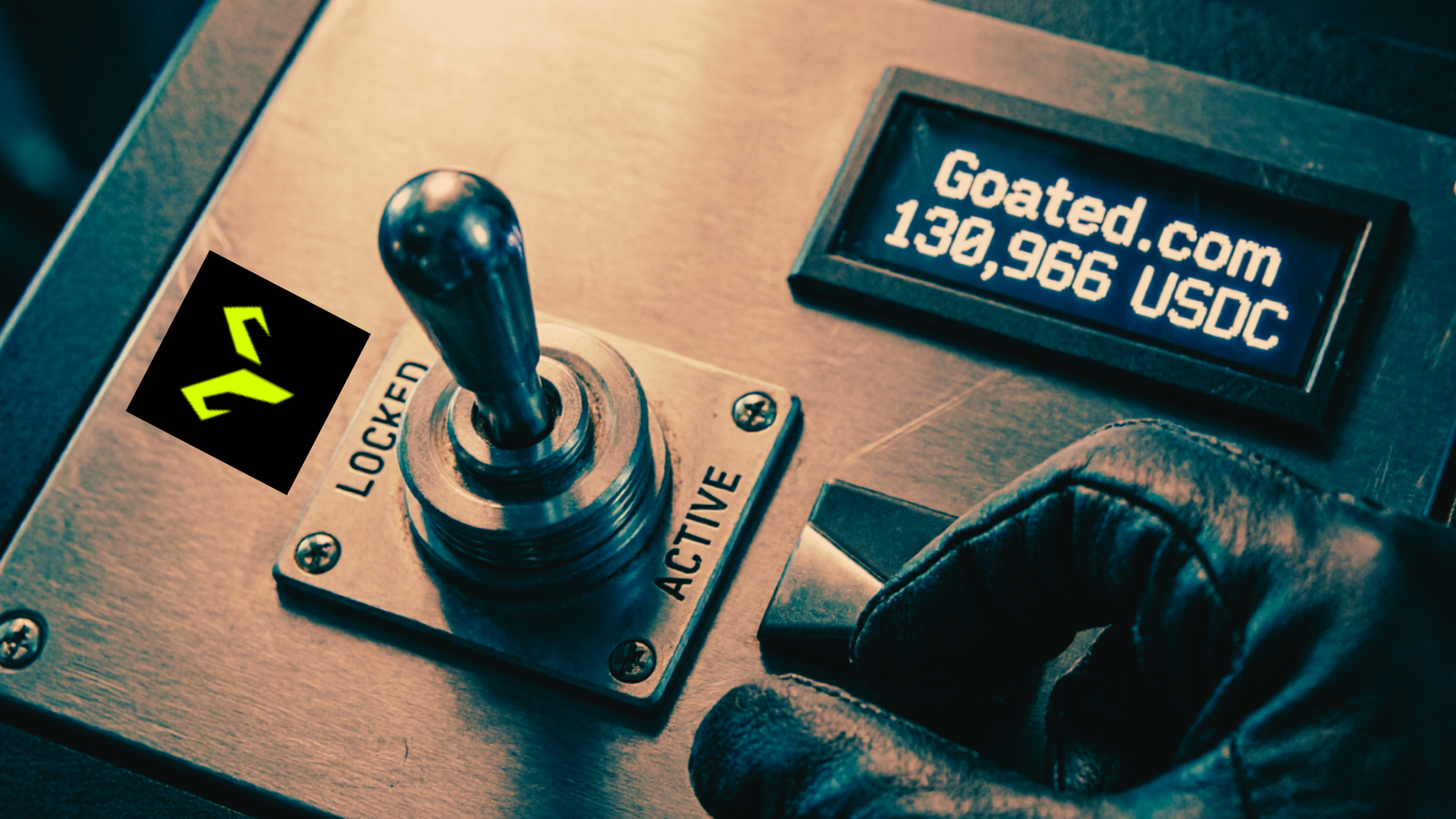

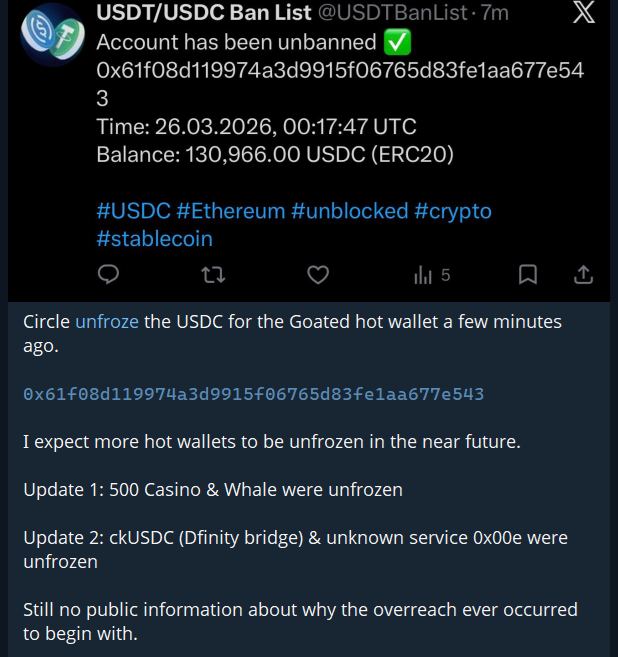
Goated.com’s operational USDC wallet came back online today. The crypto casino recovered about 130,966 USDC after a 24-hour freeze. Circle issued no announcement and provided no explanation for the initial blacklist. On-chain investigator ZachXBT flagged the unfreeze on X, noting the lack of public information regarding the move.
- Circle reverses a twenty-four-hour freeze on sixteen business wallets including Goated.com following a sealed U.S. civil case.
- Compliance teams sequestrated 130,966 USDC belonging to Goated.com without prior notice, halting thousands of daily customer transactions on March 23.
- Researcher ZachXBT warns that USDC dependency creates terminal operational risks for businesses reliant on centralized stablecoin issuer permissions.
The Blacklist and the “Sealed Case”
Circle’s compliance team blacklisted 16 hot wallets overnight on March 23. Internal records cited a sealed U.S. civil case as the catalyst. The wallets belonged to unrelated operational businesses, including exchanges, casinos, and forex platforms. Among the affected entities were Rain.gg, Clash.gg, Whale.io, Finrax, and Herofx.
ZachXBT’s on-chain review identified these addresses as legitimate business infrastructure processing high daily transaction volumes. “An analyst with basic tools could have identified within minutes that these were operational business wallets,” ZachXBT wrote. Circle appears to have bypassed that diligence or proceeded with the freeze despite the transaction history.
Operational Risk and Silent Reversals
Circle quietly restored the Goated.com wallet yesterday. Access to the funds returned without rationale. The company has not confirmed if the civil case was resolved or if the freeze resulted from a manual error. Rationales for the intervention remain private.
Businesses learned a hard lesson this week. USDC balances function as liabilities when held in Circle-controlled hot wallets. A single compliance decision, triggered by a sealed filing, can halt an entire operation. Users cannot withdraw and revenue stops.
Genuine News Deserves Honest Attention.
High-conviction projects require an intelligent audience. Connect with readers who value sharp reporting.
👉 Submit Your PRHigh-volume casinos and exchanges running on thin margins face existential risk from even 24 hours of downtime. The structural issue involves Circle’s blacklist-enabled smart contracts. The issuer alone decides who gets frozen. Events this week proved that the decision-making process lacks transparency.
The Move Toward Permissionless Rails
Goated.com’s freeze disrupted gaming flows and user withdrawals. Other affected businesses faced the same bottleneck. Smart operators are now looking to reduce USDC exposure in hot wallets or shift volume to permissionless on-chain settlement layers.
Centralized control creates avoidable operational risk. Businesses that price in vendor concentration will start treating Circle as they would any critical third-party provider. Contingency plans and balance limits are becoming a necessity.
Chain Street’s Take
The quiet unfreeze of the Goated.com wallet highlights the problem rather than fixing it. A single sealed civil case triggered a blanket freeze of 16 unrelated operational wallets. Basic on-chain diligence should have flagged them as business infrastructure. Instead, Circle acted first and explained never.
Hot wallet dependency on a centralized issuer is a measurable operational risk. Actor rationales will likely lead to trimmed USDC balances and an accelerated move toward non-freezable alternatives.
Circle’s moat rests on trust in its compliance and transparency. Events this week demonstrated a lack of both. In an industry building the future of money, centralized control can turn a settlement asset into a settlement headache instantly.
Activate Intelligence Layer
Institutional-grade structural analysis for this article.