

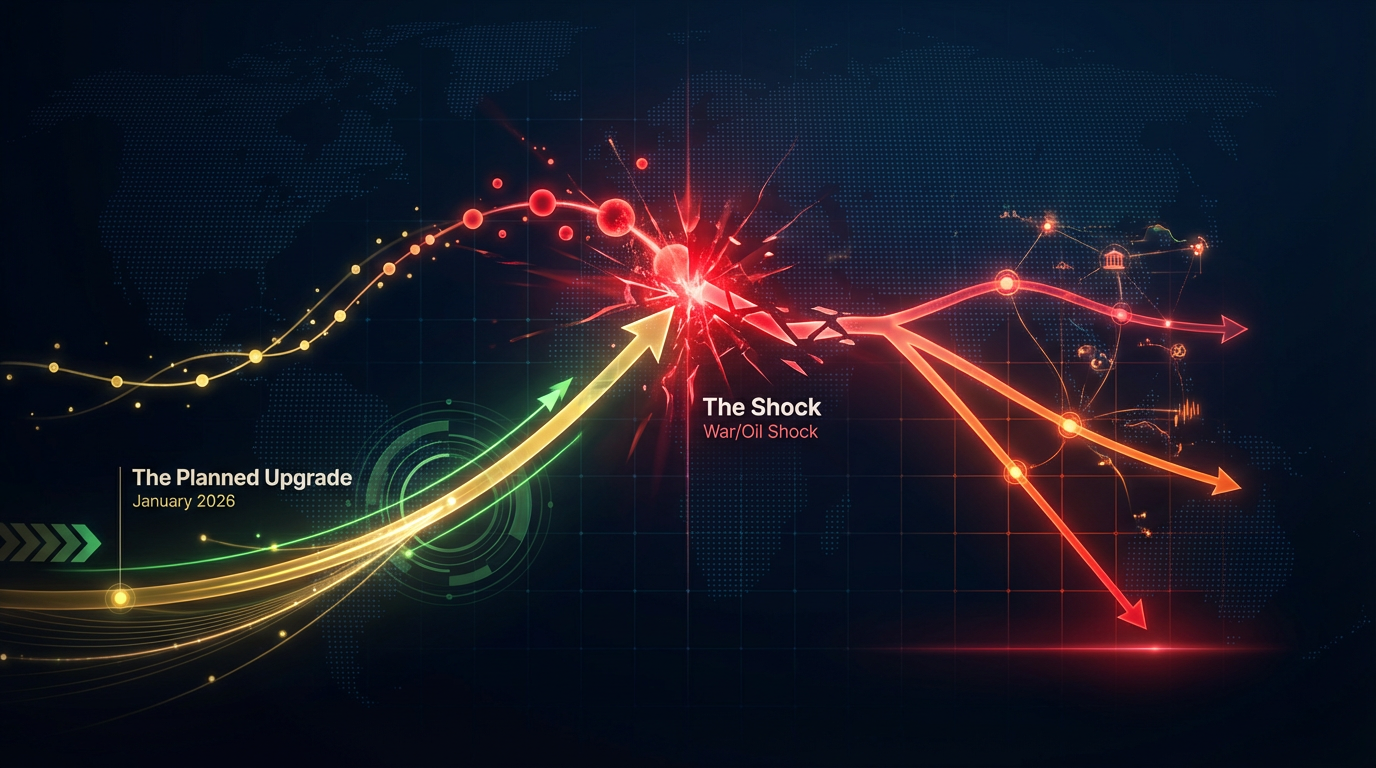

The International Monetary Fund cuts its 2026 global growth forecast to 3.1%. IMF chief economist Pierre-Olivier Gourinchas told Agence France-Presse the fund prepared to raise the number to 3.4% before the Iran war altered the outlook. The April 2026 World Economic Outlook released April 14 captured the reversal after U.S.-Israeli strikes on Iran began February 28 and sparked retaliation that disrupted energy markets.
- The IMF downgrades the 2026 global growth forecast to 3.1% following the outbreak of the Iran war on February 28.
- Brent crude prices near $100 threaten to lower expansion to 2.0%, matching levels seen during the 2009 financial crisis.
- IMF Managing Director Kristalina Georgieva warns that low-income countries require up to $50 billion in emergency balance-of-payments support.
The downgrade came from a position of relative optimism. Pre-war assumptions pointed to modest gains from technology investment and stabilizing policy conditions. The conflict instead delivered supply shocks through damaged infrastructure and constrained shipping routes in the region. Global headline inflation rose modestly in the baseline case before projected easing in 2027. Emerging market and developing economies that rely on imported energy absorbed sharper combined effects on growth and prices.
IMF Structures 2026 Global Growth Forecast Around Three Conflict Scenarios
The IMF organized its 2026 global growth forecast around three scenarios tied to the duration of the Iran war and oil prices. The reference or base case assumed limited fighting that eased by mid-2026 with oil averaging $82 per barrel. That path delivered 3.1% global growth in 2026 and 3.2% in 2027. An adverse scenario with prolonged conflict and oil near $100 per barrel this year lowered growth to 2.5%. A severe scenario that added financial market stress and oil prices averaging $110 or higher cut growth to 2.0%.
Gourinchas said the world drifted toward the adverse path as disruptions continued. “I would say that we are somewhere in between the reference scenario and the adverse scenario,” he told reporters. The 2.0% level stood out. Global growth fell below that threshold only a handful of times since 1980, including the 2009 financial crisis and 2020 COVID shock. Emerging markets and developing economies faced the largest combined hit from slower expansion and higher costs. Advanced economies recorded smaller overall revisions.
IMF Managing Director Kristalina Georgieva flagged risks for low-income countries with thin fiscal buffers. She said the fund expected near-term demand for IMF balance-of-payments support to rise to between $20 billion and $50 billion, “with the lower bound prevailing if the ceasefire holds.” The IEA, IMF, and World Bank formed a coordination group in early April to monitor spillovers across energy markets, trade, and financing needs. The heads of the three institutions met again on April 13 and warned that the impact was “substantial, global, and highly asymmetric, disproportionately affecting energy importers, in particular low-income countries.”
Genuine News Deserves Honest Attention.
High-conviction projects require an intelligent audience. Connect with readers who value sharp reporting.
👉 Submit Your PROil prices anchored every scenario. Brent crude traded near or above $100 in recent weeks after the fighting started. The baseline assumed moderation to an $82 average for the year. Higher and more persistent levels amplified inflation and reduced growth, especially for energy importers.
The cut carried weight because it reversed planned optimism rather than adjusting from a weak baseline. The January 2026 forecast sat at 3.3%. Absent the war the IMF signaled a modest upward move to 3.4%. The April report instead delivered a net downgrade amid fresh uncertainty. Downside risks included extended conflict, wider geopolitical fragmentation, or renewed trade tensions layered on already strained policy buffers.
The April 14 release showed how fast the outlook shifted. Momentum from investment assumptions gave way to energy shocks within weeks of fighting that began February 28. The IMF published the full World Economic Outlook report along with detailed chapters and blog posts that laid out the scenarios, oil price paths, and support estimates. Those materials remain publicly available for verification.
The data reflected a clear change. The fund stood ready to upgrade its 2026 global growth forecast. The Iran war produced a downgrade to 3.1% in the base case. Risks leaned lower if the conflict continued. The institutions charged with tracking global spillovers moved to coordinate their monitoring and response. The numbers recorded exactly what changed after late February.
ChainStreet’s Take
The IMF downgraded its forecast from a position of optimism rather than defense. The organization saw positive signals across technology investment and interest rate policy until the regional war turned the outlook negative in days. This reversal in market certainty carries more weight for allocators than the raw percentage points.
Central banks face a policy trap. Raising rates into energy-driven inflation creates the exact recessionary environment they hope to avoid. Developing nations lack the fiscal buffers to absorb triple-digit oil prices for multiple quarters. The IEA and IMF moved into a coordination phase for a reason. They anticipate spillovers. The window for a soft landing closed the moment oil prices drifted toward the $100 threshold.
Activate Intelligence Layer
Institutional-grade structural analysis for this article.