



ChainStreet
WHERE CODE MEETS CAPITAL
Loading prices…
Powered by CoinGecko
CRYPTO CRIME

Fake Ledger Live App on Apple App Store Drains $9.5 Million 

Malicious clone impersonating Ledger Live app steals seed phrases from more than 50 victims and routed funds through KuCoin deposit addresses.

Fake Ledger Live App on Apple App Store Drains $9.5 Million 

A fake Ledger Live app appeared in Apple’s App Store and drained $9.5 million in cryptocurrency from more than 50 victims over just one week.

Key Takeaways
  • A malicious Ledger Live clone on the Apple App Store steals $9.5 million from fifty victims through fraudulent seed phrase prompts.
  • The exploit drained $3.23 million in USDT on April 9 and moved 5.92 BTC belonging to Garrett Dutton into KuCoin.
  • This security failure contradicts Apple claims regarding App Store safety while funds circulate through more than 150 KuCoin deposit addresses.
Listen to this article

Blockchain investigator ZachXBT flagged the malicious clone on Telegram. Victims downloaded the counterfeit app and entered their seed phrases after it displayed fake error messages that copied the real Ledger interface.

Apple removed the fake Ledger Live app Monday.

Stolen funds passed through more than 150 KuCoin deposit addresses tied to AudiA6, a centralized mixing service. ZachXBT shared theft addresses across Bitcoin, EVM chains, Tron, Solana and Ripple.
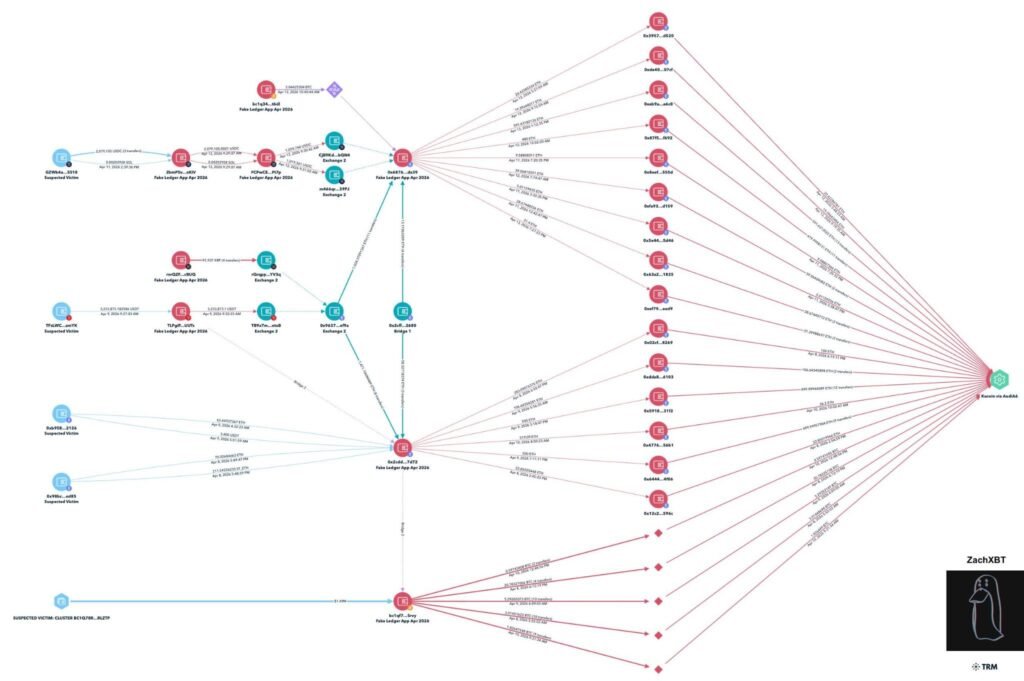
Fake Ledger Live App on Apple App Store Drains $9.5 Million credits: https://t.me/investigations
credit: @zachXBT

Three large losses stand documented. One victim lost $3.23 million in USDT on April 9. Another lost $2.079 million in USDC on April 11. A third lost roughly $1.95 million on April 8, including 20.64 BTC plus stETH and ETH.

Advertisement · Press Release

Genuine News Deserves Honest Attention.

High-conviction projects require an intelligent audience. Connect with readers who value sharp reporting.

👉 Submit Your PR

Musician Garrett Dutton, known as G. Love, lost 5.92 BTC worth about $424,000. He posted on X that he lost “my retirement fund in a hack/scam… All my BTC gone in an instant” after downloading the counterfeit app on a new MacBook and entering his 24-word seed phrase when the software prompted him with a critical error. The funds moved through nine transactions to KuCoin deposit addresses.

Fake Ledger Live App Raises Questions on Apple App Store Review

The incident draws attention to Apple’s App Store review process. The counterfeit app cleared automated scans and manual checks despite rules that bar impersonation and unauthorized data collection. Apple has issued no public statement on how the clone passed review.

Analyst Shanaka Anslem Perera highlighted the timing and broader context. “On April 3, Apple filed a Supreme Court petition arguing its App Store commission is justified by the security value of its ecosystem,” he wrote. “On April 11, five days later, a fake Ledger Live app sailed through that same ecosystem, past the automated scans, past the manual reviewers.”

KuCoin received many of the stolen funds through its deposit addresses. The exchange continues to face regulatory scrutiny following its EU onboarding ban in February 2026 and previous U.S. penalties of more than $300 million in January 2025.

ChainStreet’s Take

Self-custody users already shoulder the full weight of protecting seed phrases. A convincing fake of one of the best-known wallet brands made it through Apple’s distribution system and stole millions in days.

The rule stays blunt. Never enter recovery words into software downloaded from any app store. Verify the developer account directly and download only from official sources. Any prompt that asks for a seed phrase counts as an immediate red flag.

The $9.5 million taken in one week shows how fast trust in familiar names can turn against users. For the crypto community, vigilance around every installation source stays the only reliable defense.

CHAIN STREET INTELLIGENCE

Activate Intelligence Layer

Institutional-grade structural analysis for this article.

FAQ

Frequently Asked Questions

01

What is the fake Ledger Live app scam?

It's a malicious software clone that impersonates the official Ledger Live wallet interface on the Apple App Store. The app tricks users into entering their 24-word recovery phrases by displaying simulated critical error messages. Once a victim submits their seed phrase, the attackers immediately drain all connected cryptocurrency assets.
02

Why does this theft matter for the cryptocurrency industry?

The loss of $9.5 million highlights significant vulnerabilities in the centralized app distribution models used by Apple and Google. It demonstrates that even sophisticated self-custody users can lose millions when malicious software bypasses official store review processes. This incident increases pressure on hardware wallet manufacturers to improve user education regarding seed phrase security.
03

How did the fake Ledger app bypass Apple security?

The counterfeit application cleared Apple's automated scans and manual review checks despite strict rules against impersonation and unauthorized data harvesting. Investigators like ZachXBT noted the clone appeared on a new MacBook and operated for one week before its removal. It successfully mimicked the legitimate developer account to establish a false sense of trust.
04

What are the primary critiques of Apple following this incident?

Critics point out that Apple recently argued in a Supreme Court petition that its commission is justified by superior ecosystem security. The failure to detect a high-profile Ledger clone contradicts these claims and exposes users to massive financial risks. Legal experts suggest this event could weaken the company's defense in ongoing antitrust and security litigation.
05

How can Ledger users avoid similar App Store scams?

Users must never enter their recovery seed phrases into any software application regardless of error prompts. Hardware wallet owners should only verify transactions on the physical device screen and download updates from official manufacturer websites. If a software prompt asks for a 24-word phrase, it's a definitive sign of a malicious exploit.

You Might Also Like

CHAINSTREET
🛡
Alex Reeve

Alex Reeve is a contributing writer for ChainStreet.io. Her articles provide timely insights and analysis across these interconnected industries, including regulatory updates, market trends, token economics, institutional developments, platform innovations, stablecoins, meme coins, policy shifts, and the latest advancements in AI, applications, tools, models, and their broader implications for technology and markets.

The views and opinions expressed by Alex in this article are her own and do not necessarily reflect the official position of ChainStreet.io, its management, editors, or affiliates. This content is provided for informational and educational purposes only and does not constitute financial, investment, legal, or tax advice. Readers should conduct their own research and consult qualified professionals before making any decisions related to digital assets, cryptocurrencies, or financial matters. ChainStreet.io and its contributors are not responsible for any losses incurred from reliance on this information.