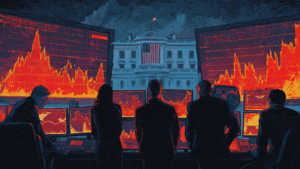


Lawmakers Adrian Smith and Nikki Budzinski introduced the PREDICT Act on Wednesday. The bill kills the ability of members of Congress and federal appointees to bet on the outcomes of their own legislation. Violators face a 10% civil penalty on the total contract value. All profits must be forfeited to the Treasury.
- Representatives Adrian Smith and Nikki Budzinski introduce the PREDICT Act to ban federal officials from trading policy-based prediction contracts.
- Violators face a ten percent civil penalty on total contract values and must forfeit all profits to the U.S. Treasury.
- The legislation treats government policy as material non-public information, forcing platforms like Polymarket to adopt stricter institutional compliance standards.
Policy as Material Information
The proposal marks a shift in how Washington views event contracts. Platforms such as Polymarket have scaled into billion-dollar venues where election results and Fed decisions trade like commodities. Knowledge from closed-door briefings now qualifies as material non-public information.
Industry observers have spent months flagging large bets placed seconds before major policy shifts. Smith and Budzinski are responding to these “suspiciously timed” entries. Using private data to trade policy-outcome contracts now carries the same legal weight as equity insider trading.
Platform Fallout
Regulated venues are already moving. Kalshi announced enhanced anti-insider protocols this month. Polymarket, which settles on-chain via Ethereum, updated its rules to flag accounts tied to U.S. officials.
Enforcement remains a technical hurdle for decentralized networks. Centralized platforms can shutter accounts. On-chain venues rely on pseudonymous wallets. Identifying trades by officials or their spouses requires advanced forensics. Most decentralized protocols still lack these compliance hooks.
Genuine News Deserves Honest Attention.
High-conviction projects require an intelligent audience. Connect with readers who value sharp reporting.
👉 Submit Your PRThe CFTC signaled its position in a February advisory. The agency highlighted “suspicious timing” around government announcements and asserted authority over event contract practices.
Liquidity and Volatility
Excluding information-privileged traders will likely move liquidity toward algorithmic strategies. Kalshi Research suggests removing these “insiders” could spike short-term volatility while improving the accuracy of long-term price discovery.
Scope of the legislation goes beyond the STOCK Act of 2012. Prediction markets settle in sub-seconds. That lack of friction makes the insider advantage more acute than in traditional stock markets.
Chain Street’s Take
The PREDICT Act is the institutionalization of event contracts. Congress is done treating these markets as curiosities. They are being regulated as infrastructure.
Political proximity used to be a source of “easy alpha.” That edge is being legislated out of existence. What remains is a market driven by sentiment analysis and genuine uncertainty.
The real test is technical: can decentralized protocols survive mandatory KYC at fiat on-ramps or post-hoc asset clawbacks? Regulators are pushing U.S. policy markets toward regulated intermediaries. The PREDICT Act isn’t a mere ban: it is a blueprint for the type of prediction markets Washington will allow to exist.
Activate Intelligence Layer
Institutional-grade structural analysis for this article.