

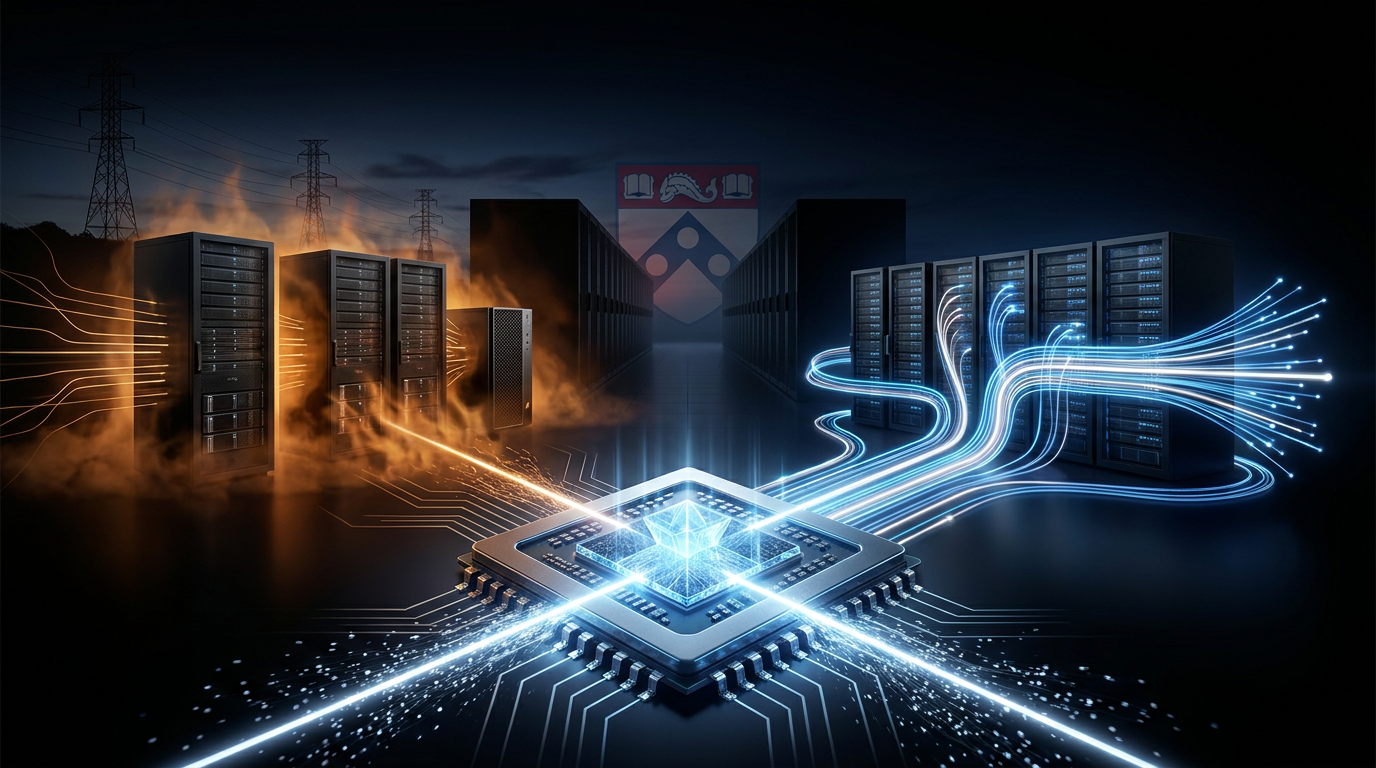

Physicists at the University of Pennsylvania develop a hybrid light-matter particle that switches signals at optical speeds while consuming a fraction of the power required by traditional silicon. The newly created hardware addresses the primary physical constraint of artificial intelligence: a looming energy wall that threatens to stall the expansion of high-performance computing.
The research team announced the breakthrough on Monday, targeting the energy inefficiency of modern data centers. The hardware utilized a polariton-based switch to operate at optical frequencies. Silicon transistors relied on the physical movement of electrons, a process that inherently generated heat and increased power consumption. The light-matter hybrid bypassed those limitations by leveraging photon-electron interactions to enable signal processing at speeds measured in femtoseconds.
Energy efficiency stood as the primary focus of the project. The laboratory prototype integrated photonic and electronic components to ensure conversion between light and electrical signals remained seamless. The architecture facilitated the rapid data processing and low latency required for intensive generative AI workloads.
Hardware constraints emerged as the primary bottleneck for artificial intelligence over the last 24 months. Some industry forecasts predicted that AI workloads would consume nearly 8 percent of the global power supply by 2030. The newly developed hybrid particle provided a hardware-level solution to reduce the electricity demand of massive data centers. Researchers suggested that the architecture could fit within existing semiconductor manufacturing pipelines, which would likely accelerate commercial deployment once the technology moves beyond the laboratory.
The UPenn project arrived as global tech firms explored new computing architectures to handle massive datasets. Scaling GPU performance remained the priority for firms like NVIDIA. Academic and industrial peers investigated alternative paradigms, including neuromorphic chips and pure optical computing. The light-matter approach specialized in bridging photonic speed with the compatibility of existing electronic systems.
Genuine News Deserves Honest Attention.
High-conviction projects require an intelligent audience. Connect with readers who value sharp reporting.
👉 Submit Your PREngineers emphasized the potential for on-device AI applications. Reduced power consumption allowed for sophisticated processing without the need for the massive infrastructure currently supporting large-scale models. The ability to minimize the carbon footprint of AI infrastructure stood as a significant secondary benefit of the optical-electronic hybrid. The University of Pennsylvania findings suggested that the next decade of AI competition will likely be determined by the efficiency of the silicon itself rather than the raw scale of data center buildouts.
Chain Street’s Take
The UPenn findings suggest the “energy wall” for AI is a hardware-based legacy problem rather than an inevitable law of physics. If signal switching moves to a light-matter hybrid, the trillions of dollars currently allocated for new power plants and massive cooling systems might require a strategic rethink. The technology moves the industry focus from scaling larger data centers to improving the efficiency of the foundational particle. The winner of the next AI cycle will likely be the entity that secures the fastest, coldest hardware rather than the one with the largest land grab for power.
Activate Intelligence Layer
Institutional-grade structural analysis for this article.