

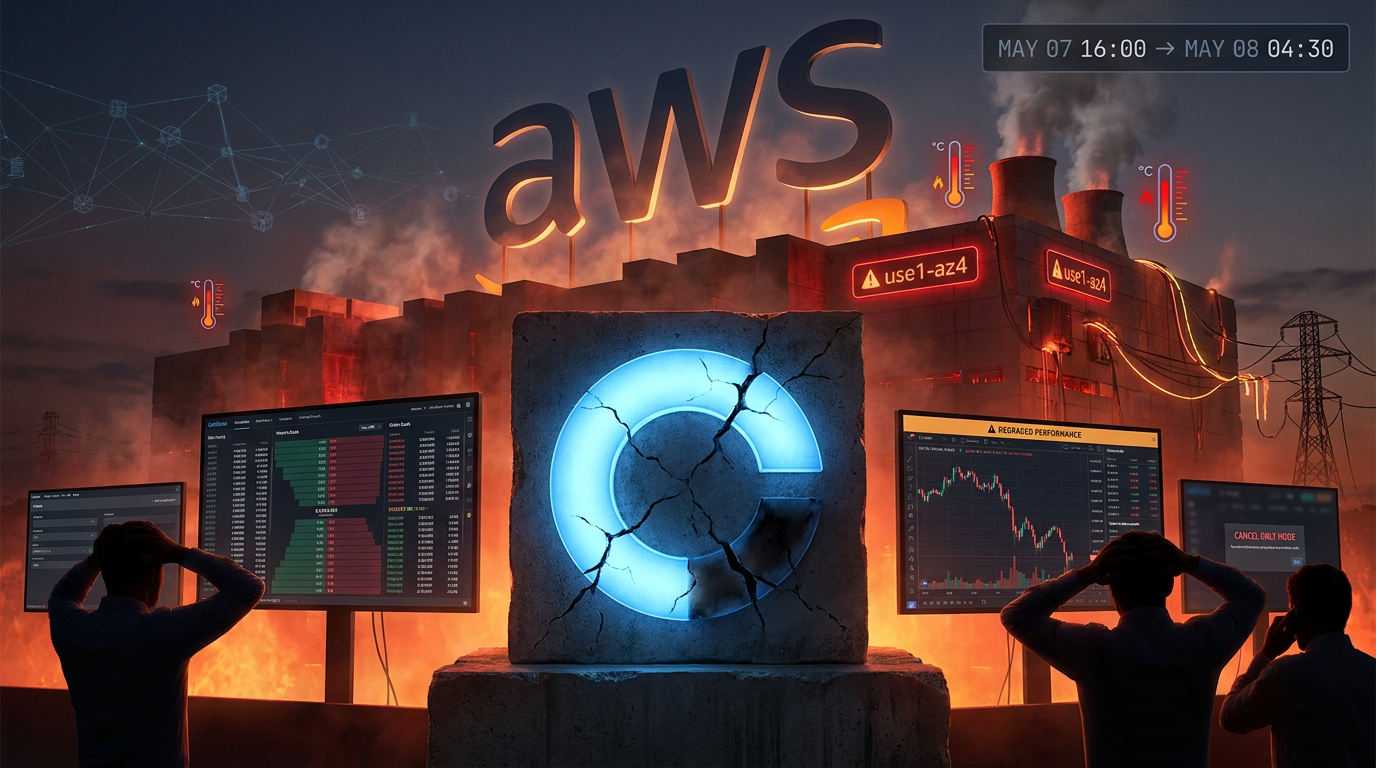

Coinbase experiences ongoing service disruptions on Friday, following an overheating event at an Amazon Web Services data center in the US East 1 region. As of 4:05 a.m. ET, several key services including the main website, mobile app, and Advanced Trade remain in degraded performance mode according to the company status page.
- Coinbase trading services remain degraded following an infrastructure-damaging overheating event at an Amazon Web Services data center in Northern Virginia.
- Elevated temperatures in the AWS use1-az4 zone caused power loss, forcing Coinbase to move markets into cancel-only trading mode.
- Persistent outages highlight the exchange's single-provider dependency on AWS while traders face restricted execution during periods of high market volatility.
The exchange first reported the issue on Thursday after elevated temperatures in the use1-az4 availability zone caused power loss and damaged infrastructure. Coinbase placed markets in Cancel Only mode during the peak of the disruption and advised users to monitor the AWS status dashboard.
Current Status And Lingering Effects
The latest status update shows persistent degradation across core trading functions. Coinbase Website, Coinbase Mobile, Advanced Trade, and Coinbase Onramp all display degraded performance. Other services including US Derivatives, International Derivatives, API, Coinbase Wallet, and Customer Support continue to operate normally.
The outage began during a period of notable market volatility, leaving many users unable to execute trades or view accurate order books for several hours. Traders reported frustration as they monitored price movements without the ability to react in real time.
Technical Background Of The Incident
AWS confirmed that the temperature spike in the Northern Virginia facility affected EC2 instances and EBS volumes in one availability zone. This zone serves as a critical part of AWS oldest and largest regional hub. Coinbase heavy reliance on this specific infrastructure exposed the platform when the thermal event occurred.This marks the latest in a series of AWS-related disruptions for Coinbase. Previous incidents in late 2025 also originated from the US East 1 region and highlighted the exchange single-provider dependency.
Genuine News Deserves Honest Attention.
High-conviction projects require an intelligent audience. Connect with readers who value sharp reporting.
👉 Submit Your PRCoinbase Communication During The Event
Coinbase Support provided regular updates throughout the outage. The team stated that customer funds remained safe and that engineers worked directly with AWS to restore services. The company advised users to use Cancel Only mode until full functionality returned.
Gergely Orosz, a prominent tech commentator, criticized the incident optics. He noted the outage occurred shortly after Coinbase CEO Brian Armstrong discussed non-technical teams shipping code to production. Orosz pointed to Coinbase deep integration with AWS as the underlying tradeoff.
Lessons For Crypto Infrastructure Resilience
The prolonged recovery highlights the challenges major cryptocurrency platforms face when critical operations depend on centralized cloud providers. While on-chain settlement offers decentralization, off-chain components such as trading engines and order books remain vulnerable to traditional data center issues.Industry analysts recommend that large exchanges accelerate geographic diversification and multi-cloud strategies. As trading volumes grow and institutional participation increases, tolerance for extended outages during volatile periods decreases significantly.
Chain Street’s Take
Coinbase outage reveals the gap between crypto marketing and operational reality. The platform promotes 24/7 global trading yet remains heavily dependent on a single cloud provider region. When that region overheats, trading stops for hours.The fact that customer funds stayed safe is reassuring. However traders who could not execute orders during market movements experienced real impact.
This incident occurred at an inconvenient time following recent leadership comments about development velocity. The juxtaposition highlights a clear tradeoff. Coinbase prioritized speed and integration with AWS. That choice delivered performance until it delivered downtime.AWS remains one of the most reliable cloud providers overall. Its dominance however means regional problems create widespread consequences.
Coinbase and other major exchanges should treat this as a prompt to diversify infrastructure. Hybrid or multi-cloud setups add complexity but also add necessary resilience for platforms handling billions in daily volume.
The broader industry continues its transition toward greater maturity. Operational resilience must match the pace of product innovation and regulatory progress. For Coinbase the path forward involves reducing single points of failure while maintaining the speed users expect. This outage serves as a practical reminder that even the largest players remain subject to physical world constraints in their data centers.
Activate Intelligence Layer
Institutional-grade structural analysis for this article.