

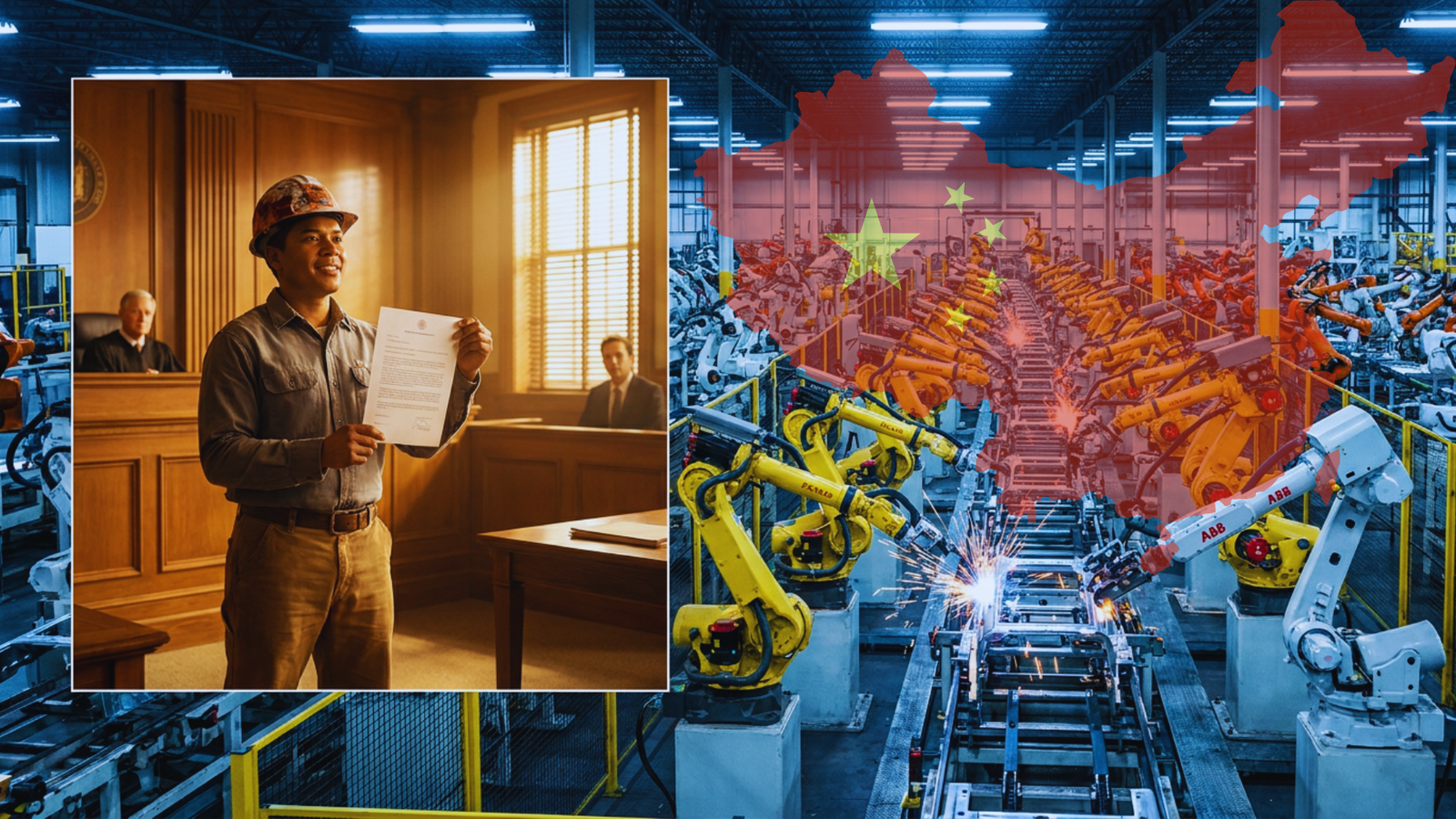

A Chinese court ruled that companies cannot fire employees and replace them with artificial intelligence purely to reduce costs. The Hangzhou Intermediate People’s Court ordered a technology firm to pay damages to a senior quality assurance supervisor whose position the company took over using an AI large language model.
- The Hangzhou Intermediate People’s Court rules that technology firms cannot terminate employees solely to replace their roles with artificial intelligence.
- A judge ordered a Hangzhou tech firm to pay 260,000 yuan in damages to an employee fired after refusing a demotion.
- The decision establishes that voluntary AI adoption does not qualify as an objective circumstance allowing for the termination of labor contracts.
The Quality Assurance Dispute
The Hangzhou Intermediate People’s Court published the case on April 28 as a typical example of protecting the rights of enterprises and workers ahead of International Workers’ Day. The worker, identified as Zhou, joined a Hangzhou-based tech company in November 2022, earning 25,000 yuan, approximately $3,640, per month. His responsibilities included matching user queries with large language models and filtering content to ensure accurate outputs.
Management informed Zhou in 2025 that AI technology upgrades made the position redundant. The firm offered to reassign him to a lower-level role with a reduced salary of 15,000 yuan per month. Zhou refused the transfer, and the company terminated his contract, citing organizational restructuring.
Legal Interpretation of Automation
Zhou contested the compensation through arbitration, which ruled the dismissal unlawful. The company filed a lawsuit with a district court in Hangzhou in August 2025 and later appealed to the intermediate court. Judges focused on whether AI-driven job replacement constituted a “major change in objective circumstances” under China’s Labor Contract Law.
The intermediate court found that the company’s decision to adopt AI technology functioned as a voluntary move to maintain competitiveness, not an unavoidable circumstance that made contract performance impossible.
Genuine News Deserves Honest Attention.
High-conviction projects require an intelligent audience. Connect with readers who value sharp reporting.
👉 Submit Your PR“The company terminated the contract not due to business closures, poor operations, or loss reduction, but based on AI’s cost advantage,” noted Judge Shi Guoqiang of the Hangzhou Intermediate People’s Court. “This does not constitute a major change in objective circumstances.”
The court also ruled that the company failed to demonstrate good-faith negotiation, as the offer for reassignment included an unreasonable pay reduction. The final order required the company to pay 2N-standard compensation, twice the statutory severance amount, totaling approximately 260,000 yuan, or about $36,000.
Social Responsibility and the Future of Work
The ruling clarified a key legal principle for the AI era. Wang Xuyang, a lawyer from Zhejiang Xingjing law firm, commented on the broader implications. “While companies may benefit from AI-driven efficiency gains, they must also bear corresponding social responsibilities,” Wang said.
Judge Shi emphasized the human rights element of the decision. “Labor contract relationships are not just civil relationships, they involve social rights,” Judge Shi noted. “While enjoying the dividends of AI technology, enterprises must also fulfill their employment protection responsibilities toward workers.”
Legal scholars emphasized that the costs of technological transformation should not fall solely on workers. “Technological progress may be irreversible, but it cannot exist outside a legal framework,” said Wang Tianyu, a researcher with the Chinese Academy of Social Sciences.
Chain Street’s Take
The Hangzhou ruling delivers a clear message to companies globally: AI adoption does not suspend labor law. The decision rejects the notion that technological efficiency alone justifies terminating human staff. By ruling that voluntary AI upgrades do not constitute a major change in objective circumstances, the court drew a firm boundary between innovation and exploitation.
For multinational firms watching the Chinese labor landscape, the ruling signals that the judicial system protects workers even as the state pushes for AI leadership. Companies that automate must do so responsibly, through fair compensation, genuine retraining offers, and transparent negotiation. The ruling reinforces a key philosophical stance: technological progress must serve human welfare, not the other way around. For the global AI industry, this case offers an early blueprint for the legal contours of automation, one where efficiency and dignity remain mutually inclusive.
Activate Intelligence Layer
Institutional-grade structural analysis for this article.