

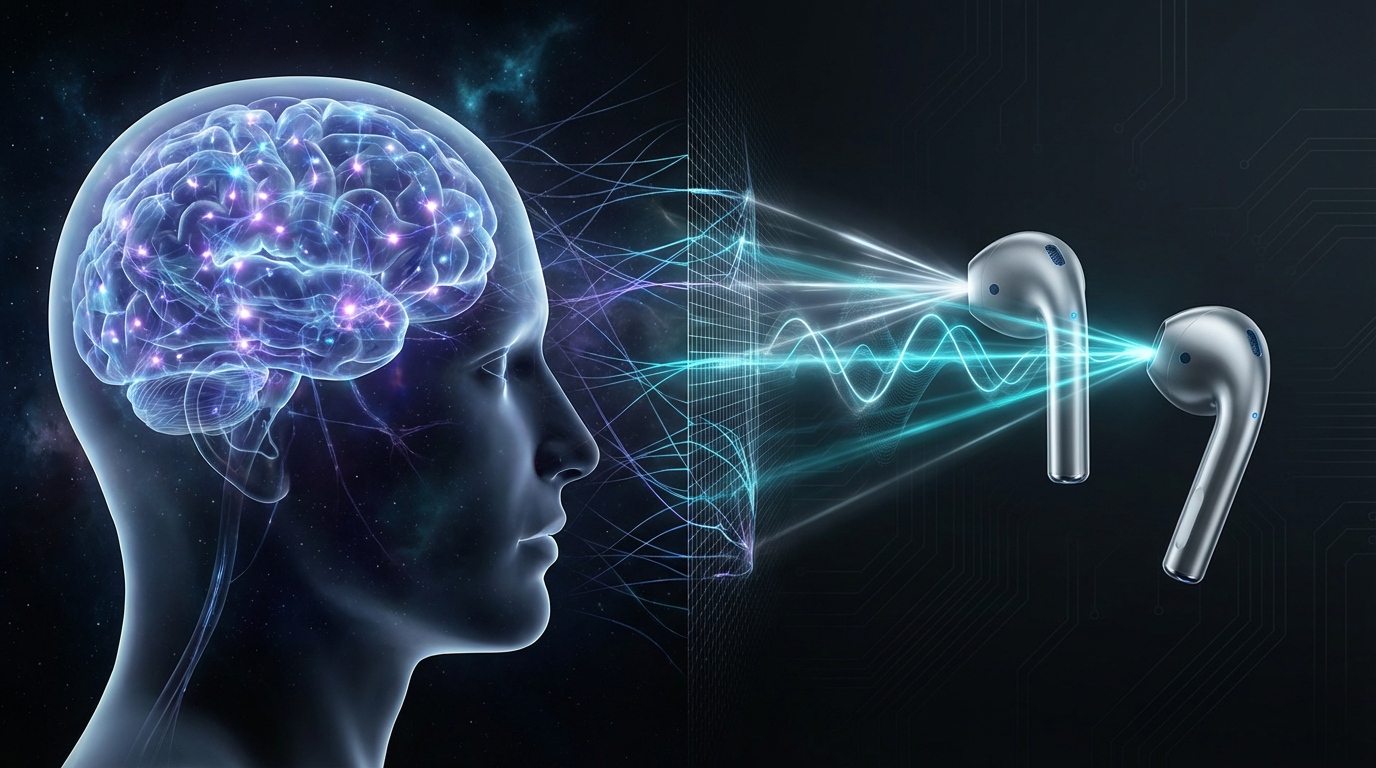

Cupertino-based tech giant Apple, is developing technology that could turn AirPods into a window into the brain, offering life-changing health insights. But there’s a catch, it demands that users hand over the most intimate data they possess.
- Apple secures patent US20230225659A1 for AirPods capable of recording EEG brain signals and biosignals through dynamic in-ear electrode selection.
- The technology monitors 3.4 million Americans with epilepsy while Colorado HB24-1058 establishes the first neural data privacy laws in August 2024.
- Massive medical benefits for cognitive health conflict with the total surrender of mental privacy in a market lacking federal neural regulation.
Apple has patented earbud technology capable of capturing EEG brain signals and other biosignals through electrodes placed inside and around the outer ear. The filing, US20230225659A1 (“Biosignal Sensing Device Using Dynamic Selection of Electrodes”), outlines a smart system that dynamically selects the best sensors for accurate, low-power readings. Filed in January 2023 and published in July 2023, it remains a patent only. Apple has issued no product announcement and no such AirPods exist today.
The Health Benefits That Make the Trade-Off Seductive
The potential medical value is substantial. Apple researchers in November 2025 published work on advanced self-supervised EEG analysis for wearables, demonstrating how in-ear sensors could detect seizure patterns, map detailed sleep stages, monitor stress in real time, and flag early cognitive changes. For the 3.4 million Americans with epilepsy, continuous discreet monitoring could deliver early warnings and prevent injuries without cumbersome hospital equipment. Similar advantages apply to sleep disorders, anxiety tracking, and focus optimization.
Neurotech ethics expert Dr. Nita Farahany has articulated the appeal powerfully. She stated that wearable brain sensors could enable people to “peer into your own brain health and wellness, and your attention and your focus, and even potentially your cognitive decline over time.”
The Brutal Privacy Cost That Should Make You Hesitate
Neural data is in a league of its own. Unlike heart rate or step counts, brain waves can expose attention levels, emotional states, stress responses, early neurological risks, and potentially fragments of thoughts before you consciously express them. This level of access to the human mind has never before existed in mass-market consumer devices.
Genuine News Deserves Honest Attention.
High-conviction projects require an intelligent audience. Connect with readers who value sharp reporting.
👉 Submit Your PRDr. Farahany issued clear warnings on this exact scenario. She describes neural data as “uniquely sensitive because it can reveal what someone is thinking before they decide to share it.” She has also cautioned that future devices may leave users little real choice: “your only option will be to get the devices that have the neural sensors in them.”
U.S. regulation lags far behind the technology. Only a few states have stepped up. Colorado’s HB24-1058, effective August 2024, was the first to classify neural data as “sensitive personal information,” demanding explicit consent and banning its sale for advertising. California and Montana followed with similar rules. At the federal level, meaningful protections are almost nonexistent. This vacuum allows companies to market neural features as casual “wellness” tools while collecting clinically rich brain data with minimal oversight.
The Slippery Slope Risks
Once collected, such data could be vulnerable to breaches, employer monitoring, insurance adjustments based on cognitive patterns, or even law enforcement requests. The constant presence of earbuds in daily life amplifies the stakes, turning an everyday accessory into a potential always-on mental monitor.
Chain Street’s Take
Apple’s patent forces a raw, unavoidable question: How much of your inner mental life are you willing to surrender for better health data? The medical promise is real and compelling. The privacy price is unprecedented in its intimacy.
Right now the law offers little more than patchwork state rules and corporate assurances. Before these sensors ship and the data starts flowing, consumers and regulators must confront whether this trade-off is truly acceptable, or whether some parts of the human mind should remain beyond the reach of even the most advanced consumer gadgets. The choice is coming sooner than most realize.
Activate Intelligence Layer
Institutional-grade structural analysis for this article.