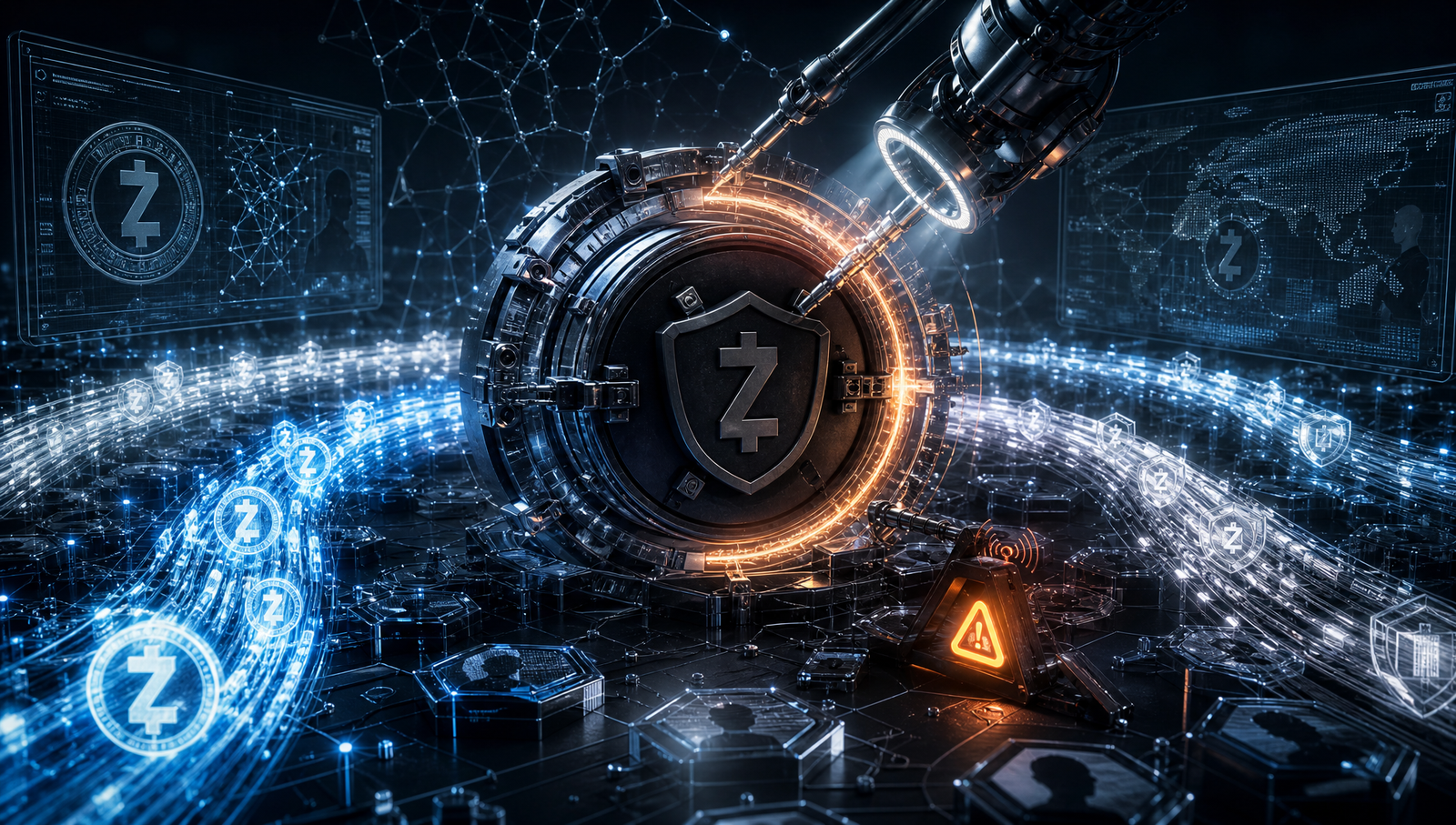

Zcash is not down, but its most advanced privacy layer just went dark for hours as developers raced to fix a critical soundness bug in the Orchard shielded pool, triggering widespread outage panic online.
- Zcash maintainers execute an emergency soft fork to patch a critical soundness bug in the Orchard shielded pool, preventing potential double-spend vulnerabilities.
- The Orchard pool, holding 4.5 million ZEC (30% of supply), was temporarily disabled while transparent and Sapling transactions continued processing.
- Despite widespread social media rumors of a total network outage, the protocol remained functional, protected by the Zcash "turnstile" supply-integrity mechanism.
Zcash maintainers executed a rapid emergency soft fork early this month to fix a soundness vulnerability in the Orchard zero-knowledge proof circuit. The coordinated upgrade temporarily halted Orchard transactions for several hours but never took the full network offline. Transparent and Sapling shielded transfers kept processing normally throughout.
The bug was discovered on May 29, during a routine security audit by researcher Taylor Hornby in the halo2_gadgets library used by Orchard. Zcash Open Development Lab (ZODL) confirmed the issue quickly. The vulnerability could have allowed invalid state transitions inside the Orchard pool, potentially enabling double-spends within that specific shielded pool — but Zcash’s turnstile mechanism protected the overall ZEC supply.
Orchard held more than 4.5 million ZEC at the time, roughly 30% of the circulating supply. On Tuesday around 02:00 UTC (block height 3,363,426), Zebra 4.5.3 activated an emergency soft fork that instructed nodes to reject any blocks or transactions containing Orchard actions.
This created a visible slowdown in block production for more than four hours, including periods of no new blocks and several orphaned blocks as miners and node operators upgraded at different speeds.Many block explorers relying on unpatched nodes displayed frozen metrics. That fueled widespread social media claims of a full chain outage.
Genuine News Deserves Honest Attention.
High-conviction projects require an intelligent audience. Connect with readers who value sharp reporting.
👉 Submit Your PRThe Zcash Foundation released Zebra 5.0.0 shortly afterward. NU6.2 activated at block height 3,364,600 around 00:05 EDT on June 3, re-enabling Orchard with the corrected circuit. The network returned to normal block cadence by early June 3.
User funds remained secure and exchanges maintained uninterrupted ZEC trading throughout. The Zcash Foundation shared: “Zcash’s turnstile mechanism confirmed that the total supply remained intact throughout. There is no evidence of unauthorized value creation.”
ZODL Founder Josh Swihart addressed the confusion directly on X saying, “Zcash was never down. Many block explorers have been using unpatched nodes. Happens with every network update. Fight the FUD.”
Chain Street’s Take
This was never a chain collapse or exploit. It was a targeted, preventative pause on Zcash’s flagship privacy layer to fix a real soundness bug caught in audit. The response was fast, coordinated, and effective, exactly what you want when serious money sits in shielded pools.
The optics, however, were messy. The slowdown looked serious enough on explorers to trigger “network down” panic, and the emergency fork in the most advanced privacy feature raised legitimate questions about design trade-offs. Zcash’s model allows quick fixes, which is a clear advantage in a crisis. However, it also depends on a small group that can effectively change consensus rules.
Activate Intelligence Layer
Institutional-grade structural analysis for this article.