


ChainStreet Briefing
- President Trump's tariff announcement on October 10, 2025, caused over $19 billion in crypto liquidations.
- Bitcoin plunged 16% to $101,500, with altcoins seeing drops as severe as 90%, erasing nearly $1 trillion in market cap.
- The precise timing of massive short positions taken by a known whale raises serious questions of potential market manipulation.
- President Trump’s tariff announcement on October 10, 2025, caused over $19 billion in crypto liquidations.
- Bitcoin plunged 16% to $101,500, with altcoins seeing drops as severe as 90%, erasing nearly $1 trillion in market cap.
- The precise timing of massive short positions taken by a known whale raises serious questions of potential market manipulation.
On October 10, 2025, the cryptocurrency market buckled under a brutal, record-setting liquidation event, as President Donald Trump’s snap announcement of a 100% tariff on all Chinese imports sent asset prices plummeting and fueled accusations of insider trading.
This unprecedented cascade of forced selling eradicates over $19 billion in leveraged positions, dwarfing previous historic crashes, with QuintenFrancois, Co-founder of WeRate_Official, starkly contrasting it: “Covid crash: $1.2B in liquidations. FTX crash: $1.6B in liquidations. Today: $19.31B in liquidations.
The Tariff Trigger and Unprecedented Market Carnage
President Trump’s announcement, delivered from the White House podium, blindsided global markets. Within minutes, the S&P 500 fell over 2%, marking its sharpest single-day drop since April.
The cryptocurrency sector experienced a far more dramatic shock. Bitcoin plunged 16%, hitting $101,500 before a partial rebound, while altcoins entered a freefall, with most dropping 70% to 90% within minutes.
Genuine News Deserves Honest Attention.
High-conviction projects require an intelligent audience. Connect with readers who value sharp reporting.
👉 Submit Your PRThe Coinglass chart starkly illustrates the scale of long liquidations that spiked dramatically on October 10, mirroring the sudden price decline.
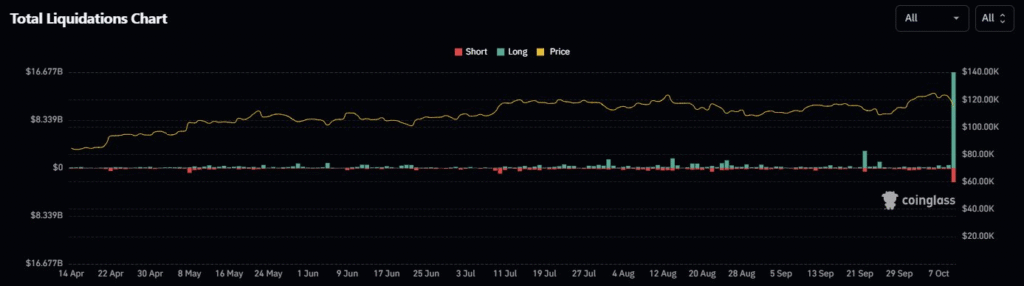
This sheer volume of forced selling led to a total of $19.13 billion in liquidations, impacting 1,618,240 traders in a 24-hour period, according to Coinglass data. This figure is likely an underestimate, with some analysts suggesting real exposure was closer to $40 billion to $50 billion.
Major crypto platforms such as Binance and Aave successfully managed the massive surge in trading activity, reporting minimal operational issues. Amid the chaos, a notable market dynamic emerged: institutions like BlackRock were reportedly accumulating Bitcoin during the dip, positioning themselves for a potential recovery. Even stablecoins were affected, with USDE depegging by 35% to 40% during the crash.
Manipulation Allegations Fuel Outrage
The timing of certain market movements before the official announcement has ignited accusations of sophisticated market manipulation. As detailed by BullTheoryio, just two days prior to Trump’s Truth Social post, “one of Bitcoin’s oldest wallets suddenly started opening large short positions on $BTC and $ETH worth billions. No catalyst. No headlines. Just silent movement onchain.”
Suspicion deepened when, merely 30 minutes before Trump’s official White House announcement, “that same whale doubled their short exposure.” This perfectly timed maneuver allowed the entity to close positions for an estimated $200 million profit as markets crashed.
“This feels like engineered manipulation to make sure no longs are left on alts,” stated Ashcryptoreal, reflecting a widespread sentiment among traders. The emotional toll on thousands of retail traders remains significant, with Ashcryptoreal observing, “The sad part is that 1000s of people who grind 24/7 got completely wiped out even with 2x leverage and will never be the same again.”
ChainStreet’s Take: A Deeper Look Beyond the Crash
This record-setting liquidation event serves as a stark reminder of the crypto market’s profound sensitivity to macro-economic policy shifts and the systemic risks embedded in highly leveraged environments. While some analysts, like BullTheoryio, frame this as a necessary “leverage cleanse,” arguing that “History says these purges don’t end bull runs, they restart them”—the incident’s underlying implications extend far beyond a simple market reset.
The allegations of pre-planned manipulation, regardless of their ultimate legal verification, cast a long shadow over the integrity of digital asset markets, especially when such significant events coincide with public policy announcements. For investors, analysts, and policymakers, this demands renewed scrutiny into market surveillance mechanisms and the transparency of large institutional trades.
Furthermore, the volatility, coupled with the depegging of a major stablecoin, will undoubtedly fuel calls for more robust regulatory frameworks, particularly concerning derivatives, stablecoin reserves, and overall market conduct. For builders in the digital economy, it underscores the critical need for resilient infrastructure and risk management tools to withstand such extreme pressures. The question isn’t just if another such event will occur, but how the ecosystem can evolve to mitigate its devastating impact on millions of participants.
Activate Intelligence Layer
Institutional-grade structural analysis for this article.