

A prominent blockchain architect classifies every decentralized finance (DeFi) protocol as fundamentally unsafe today. Manuel Aráoz, the developer behind several foundational infrastructure projects, including @OpenZeppelin, identifies the emergence of superhuman AI coding agents as an existential threat that tilts the landscape of smart contract security toward total asymmetry.
- Manuel Aráoz identifies superhuman AI coding agents as an existential threat to Aave, MakerDAO, and other major DeFi protocols.
- DefiLlama reports $1.8 billion vanished from DeFi in 2026, though less than 10 percent resulted from core smart contract exploits.
- Risk analysts like Marc Zeller argue that human operational failures, not machine-scale code attacks, remain the primary threat to industry stability.
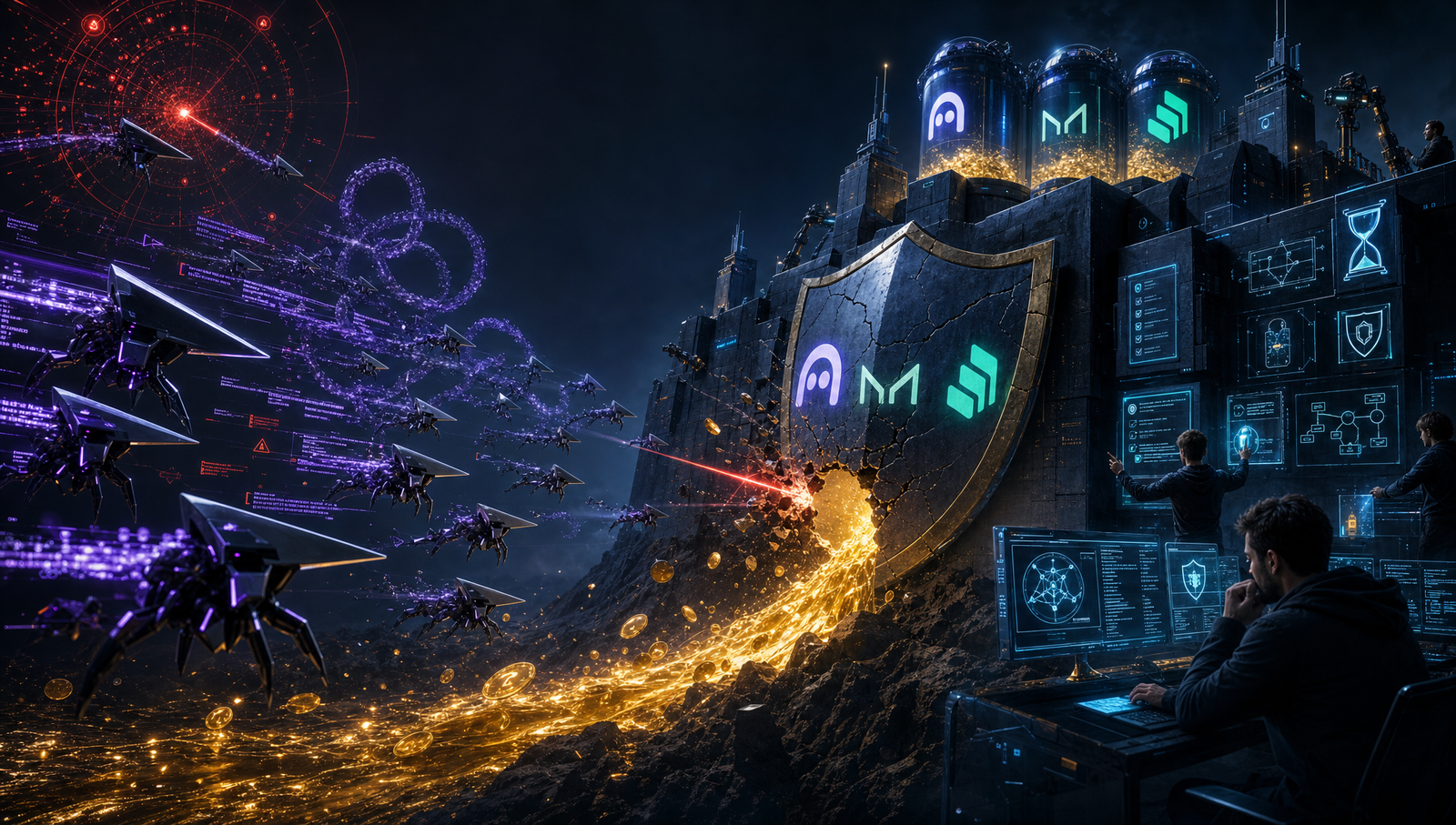
Aráoz issued his public warning this week, advising peers and family members to liquidate positions in even the most established “blue chip” protocols. He specifically named Aave, MakerDAO, and Compound as assets no longer capable of guaranteeing fund safety against machine-led exploitation. “Coding agents are superhuman at finding vulnerabilities, and smart contract security is too asymmetric: defenders need to fix every bug while attackers need just one exploit to steal funds,” Aráoz said.
The warning arrived as the decentralized sector managed a significant, yet shifting, loss profile. On-chain security firms reported that approximately $1.8 billion vanished from DeFi protocols between January and May 2026. While the figure remained below the catastrophic peaks seen in 2022, the methodology of the attacks evolved. Security data from DefiLlama and Chainalysis indicated that a heavy majority of these losses resulted from human-centric failures. Management of administrative keys, poor parameter configuration, and oracle manipulations accounted for the bulk of the $1.8 billion drain, rather than flaws in the core immutable code of audited protocols.
The DeFi community responded to the Aráoz assessment with sharp division. Marc Zeller, a veteran risk analyst, rejected the premise of a code-based apocalypse. “What a moronic thing to say. Less than 10 percent of past year DeFi issues are due to codebase. It’s mostly bad parameter configuration, collateral blow up and poor opsec,” Zeller argued. Sam MacPherson, another prominent voice in the sector, echoed the sentiment by noting that the smart contracts of major protocols remained secure despite the increasing frequency of external operational breaches.
Technical experts focused on the dual-use nature of the AI tools Aráoz described. Octane Security noted that if agents possessed superhuman capabilities for finding flaws, those same systems were equally capable of securing a network. “The only question is who finds your vulnerabilities first. There’s zero reason to let an attacker beat you to the punch,” the firm noted in a technical rebuttal. Robert Polaris added that actual smart contract exploits became a rarity in the “Lindy” era of immutable code. He suggested that recent headlines involved centralized components allowing for human control, which he defined as a failure of decentralization rather than a failure of DeFi itself.
Genuine News Deserves Honest Attention.
High-conviction projects require an intelligent audience. Connect with readers who value sharp reporting.
👉 Submit Your PRJacob Franek provided a forward-looking perspective, suggesting that the current vulnerability window was a temporary technical hurdle. Franek identified unreleased models like Anthropic’s Mythos as the eventual solution for formal verification. He argued that developers would soon use the same machine-intelligence levels to eliminate attack surfaces entirely before shipping code.
The debate highlighted a fundamental shift in how the industry perceives risk. While Aráoz focused on the machine’s ability to find the “one exploit” that bypasses an audit, his critics focused on the “no code” solutions currently available to mitigate major losses. Circuit breakers, time locks, and automated liquidation guardians became standard features for protocols attempting to survive the 2026 environment.
Chain Street’s Take
Aráoz’s warning reveals the psychological toll of the AI arms race on the people who actually build the rails of the digital economy. The fear of “superhuman” agents finding a needle-sized flaw in a $100 billion haystack is valid, yet the $1.8 billion lost this year proves that humans are still much better at breaking protocols through bad settings than machines are at cracking code. Investors should worry less about the “perfect exploit” and more about the “clumsy admin.” If the industry adopts AI-driven formal verification faster than the hackers can script their agents, the “blue chips” will likely emerge from this period more resilient than ever. Trust is currently moving away from human auditors and toward machine-checkable mathematical proofs.
Activate Intelligence Layer
Institutional-grade structural analysis for this article.