

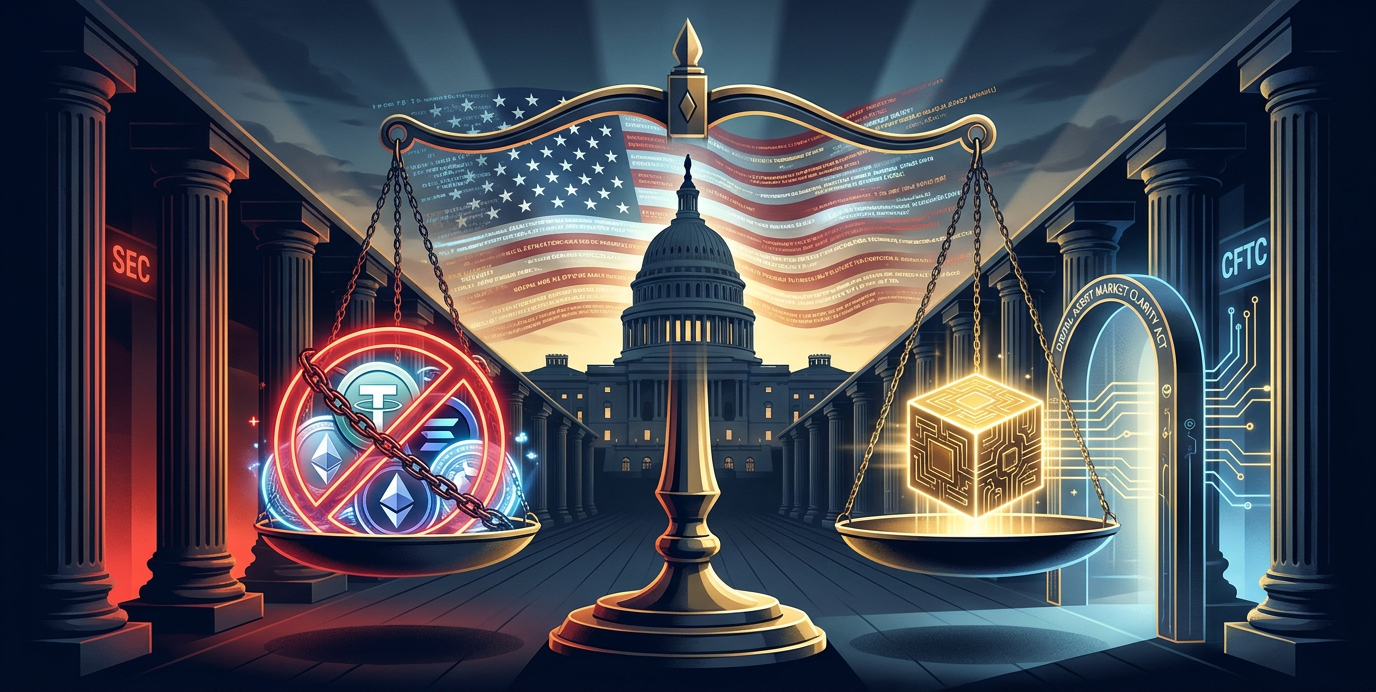

The Senate Banking Committee releases late Monday the full text of its landmark crypto framework on May 11, 2026, aiming to resolve years of jurisdictional infighting between the SEC and CFTC. The 309-page Digital Asset Market Clarity Act introduces a rigorous certification process for network tokens and imposes a strict prohibition on interest-bearing stablecoins.
- The Senate Banking Committee unveils the 309-page Digital Asset Market Clarity Act to resolve jurisdictional disputes between the SEC and CFTC.
- The legislation establishes a 49 percent control threshold for tokens seeking commodity certification and mandates full implementation by July 2027.
- Bipartisan lawmakers impose a strict interest ban on payment stablecoins to prevent digital assets from functioning as unregulated bank deposits.
The draft arrived nearly a year after the House of Representatives passed its own version of the bill in July 2025. Lawmakers designed the Senate version to create a comprehensive regulatory perimeter, addressing stablecoin issuance, decentralized finance security, and market structure. The legislation established a timeline for full implementation by July 2027, with grandfathering provisions for assets acquired before May 10, 2026.
Permitted payment stablecoin issuers faced a significant restriction under the proposed rules. The draft explicitly prohibited these entities from paying interest or any “economically equivalent” return to holders simply for maintaining a balance. This provision aimed to stop stablecoins from functioning as unregulated bank deposits. While the bill banned passive yields, it allowed for activity-based rewards tied to actual network usage, subject to joint rulemaking by the Treasury, SEC, and CFTC.
The legislation introduced a formal pathway for network tokens to achieve “digital commodity” status under the CFTC. To qualify, projects had to prove no single person or entity controlled more than 49% of the tokens or voting power. Governance was required to operate through transparent, rules-based consensus. The draft allowed developers to submit their certification to the SEC, which then had a 60 to 90 day window to lodge an objection. If the agency remained silent, the commodity certification became effective automatically.
Cybersecurity for decentralized protocols received attention in Section 306. The bill established a voluntary program that encouraged DeFi developers to adopt NIST standards for smart contract security and operational resilience. Protocols that underwent independent audits and met these criteria earned a formal compliance recognition. While the program stayed voluntary, it signaled a federal preference for protocols that adhere to recognized safety benchmarks.
Genuine News Deserves Honest Attention.
High-conviction projects require an intelligent audience. Connect with readers who value sharp reporting.
👉 Submit Your PRThe Banking Committee also mandated several high-stakes studies due within 12 to 18 months of enactment. These reports focused on digital asset mixers, financial stability risks in DeFi, and the role of foreign intermediaries. Lawmakers intended for these findings to guide future privacy and systemic risk regulations.
The proposal clarified that the SEC would retain oversight of investment contracts while the CFTC managed digital commodities. A micro-innovation sandbox was also included to allow firms to test new digital asset activities under limited regulatory relief.
Chain Street’s Take
The Clarity Act draft is a peace treaty between the SEC and CFTC, but it puts the SEC in a defensive crouch by forcing a “speak now or forever hold your peace” objection window on new tokens. The 49% decentralization threshold is the new gold standard. It gives developers a clear target to hit if they want to escape the “security” label, but it doesn’t give them a free pass.
The ban on stablecoin interest is the real dagger. It effectively kills the business model for “yield-bearing” stables that compete with traditional banks. Lawmakers are clearly worried about a shadow banking system that doesn’t have FDIC-style protections. For the DeFi sector, the voluntary cybersecurity standards are a carrot, not a stick, but you can bet that “compliant” protocols will get better insurance rates and more institutional flow. The bill isn’t perfect, but it finally ends the era of regulation by enforcement.
Activate Intelligence Layer
Institutional-grade structural analysis for this article.