


ChainStreet
WHERE CODE MEETS CAPITAL
Loading prices…
Powered by CoinGecko
Cryptocurrency

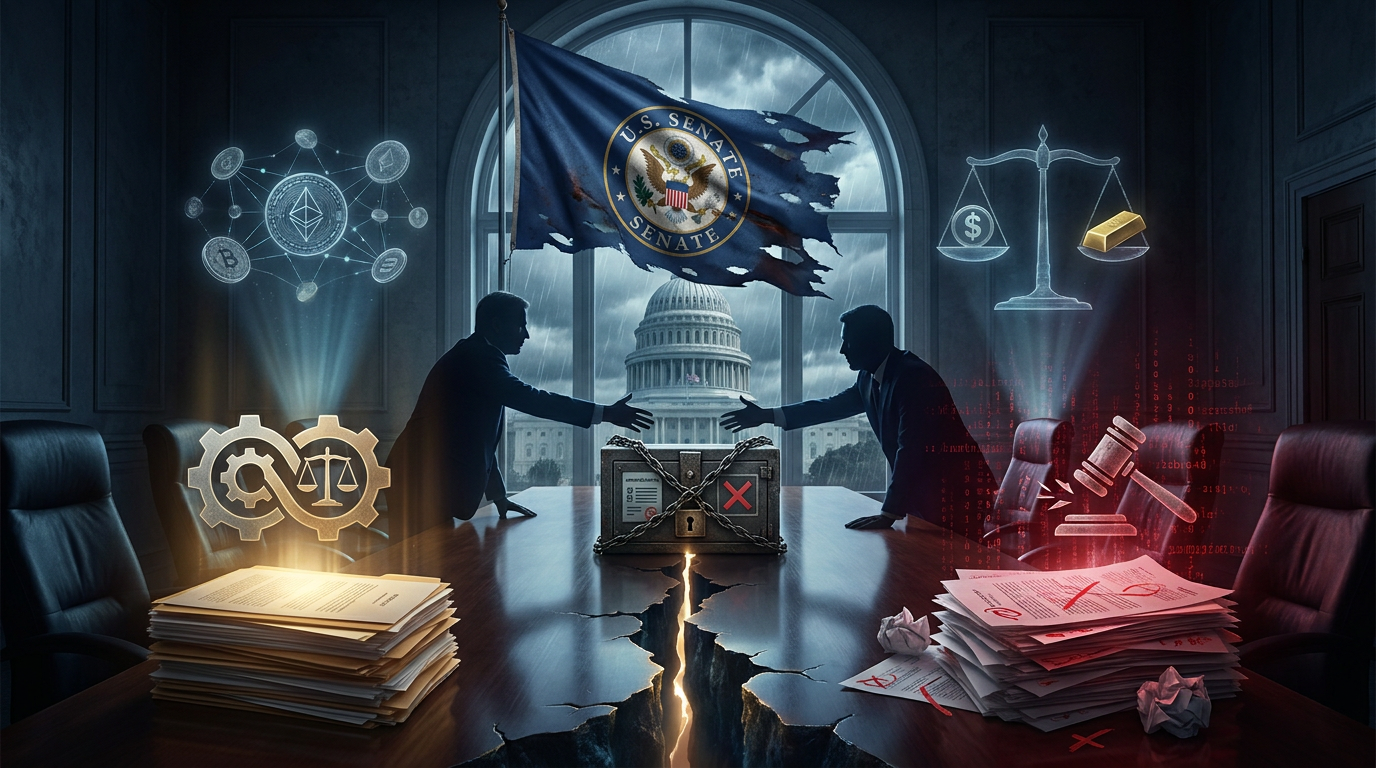
Senate Banking Committee Clarity Act Talks Collapse Before Markup

Bipartisan negotiations stall over ethics language and drafting errors as Senator Tim Scott rejects 15 amendments.

Senate Banking Committee Clarity Act Talks Collapse Before Markup

The U.S. Senate Banking Committee fails to reach a last-minute compromise on the Digital Asset Market Clarity Act on May 11, 2026. The breakdown occurs despite lawmakers reaching a 99 percent agreement on the substantive provisions of the 309-page legislative framework.

Key Takeaways
  • The Senate Banking Committee fails to finalize the Digital Asset Market Clarity Act after bipartisan compromise efforts collapse on May 11.
  • Negotiators reached agreement on 99 percent of the 309-page bill before Senator Tim Scott rejected 15 technical amendments.
  • Unresolved ethics language from Adam Schiff and drafting errors stall federal efforts to clarify SEC and CFTC regulatory boundaries.
Listen to this article
READY

The negotiations dissolved late Monday after months of attempts to reconcile the Senate’s version with the legislation the House of Representatives passed in July 2025. Senator Cynthia Lummis, a primary sponsor of the bill, confirmed that the talks reached a stalemate over demands for “stronger ethics language” from Democrats Adam Schiff and Ruben Gallego. The requirement for these additional ethics clauses prevented a final agreement on the draft before the scheduled committee action.

Journalist Eleanor Terrett reported that unresolved disputes surrounding the Blockchain Regulatory Certainty Act also acted as a primary roadblock to a final consensus. Senator Tim Scott, Chairman of the Senate Banking Committee, rejected more than 15 proposed amendments. Scott cited specific “drafting errors” in the submitted texts, a procedural issue that prevented the committee from advancing a clean, bipartisan package to the floor.

The Digital Asset Market Clarity Act aimed to establish a definitive federal regulatory structure for the digital asset economy. It proposed comprehensive rules for stablecoin issuance and created a certification pathway for network tokens to qualify as digital commodities under CFTC jurisdiction. The legislation sought to clarify the specific boundaries between the SEC and the CFTC, a point of contention that has plagued the industry for years. Negotiators reached a consensus on nearly all of these substantive sections before the final hurdles emerged.

The markup hearing is now likely to proceed along partisan lines. The House of Representatives secured strong bipartisan support for its version of the Clarity Act nearly a year ago, which set the stage for a potential reconciliation if the Senate version advances. The lack of a unified front in the Banking Committee now introduces significant uncertainty into the timeline for comprehensive federal crypto rules.

Advertisement · Press Release

Genuine News Deserves Honest Attention.

High-conviction projects require an intelligent audience. Connect with readers who value sharp reporting.

👉 Submit Your PR

Industry participants expressed disappointment as the failure to reach a deal delayed long-awaited clarity on asset classification and stablecoin oversight. The bill included transition periods and grandfathering for assets acquired before May 10, 2026, and scheduled full implementation for July 2027. The collapse of the talks follows a year of intense lobbying from both consumer advocates and industry players seeking to establish a clear legal perimeter for blockchain technology.

Chain Street’s Take

The breakdown of the talks reveals that even near-total alignment on policy substance can be derailed by procedural and ethics details. With 99 percent of the bill agreed upon, the remaining 1 percent proved decisive in stalling the bipartisan momentum. The bill now enters a more partisan environment, but the core framework remains intact. Whether the legislation can survive a divided markup and eventually reach reconciliation with the House remains the primary question for the 2026 legislative session.

0views·1AI reads

CHAIN STREET INTELLIGENCE

Activate Intelligence Layer

Institutional-grade structural analysis for this article.

FAQ

Frequently Asked Questions

01

What is the Digital Asset Market Clarity Act?

The Digital Asset Market Clarity Act is a 309-page bipartisan bill designed to establish a federal regulatory framework for the US cryptocurrency market. It proposes specific rules for stablecoin issuance and creates a pathway for tokens to be classified as commodities under the CFTC. The legislation aims to resolve long-standing jurisdictional conflicts between the SEC and other financial regulators.
02

Why does this talk collapse matter for the crypto industry?

The breakdown delays long-awaited legal certainty regarding asset classification and stablecoin oversight for US-based firms. The bill reached 99 percent consensus before hitting stalemates over ethics language and procedural drafting errors. Until this framework passes, digital asset companies remain subject to conflicting enforcement actions from various federal agencies.
03

How will Senator Tim Scott proceed with the markup?

The Senate Banking Committee Chairman will likely move forward with a partisan markup hearing following the breakdown of bipartisan talks. Tim Scott rejected more than 15 amendments citing technical inaccuracies and unresolved disputes with Democrats Adam Schiff and Ruben Gallego. A partisan vote reduces the likelihood of the bill reaching a successful reconciliation with the version passed by the House.
04

What are the primary roadblocks in the Clarity Act negotiations?

Disagreements over "stronger ethics language" and the Blockchain Regulatory Certainty Act represent the primary obstacles to a final agreement. Senator Cynthia Lummis confirmed that demands from Adam Schiff prevented the committee from advancing a clean, bipartisan legislative package. These minor disputes over procedural language threaten to derail months of substantial progress on core financial policy.
05

How will the Senate reconcile the bill with the House version?

The Senate must first pass its version before beginning a reconciliation process with the July 2025 House legislation. The existing House bill secured strong bipartisan support, providing a template for a final unified federal crypto framework. The lack of a unified Senate front complicates the implementation timeline currently scheduled for July 2027.

You Might Also Like

CHAINSTREET
🛡
Alex Reeve

Alex Reeve is a contributing writer for ChainStreet.io. Her articles provide timely insights and analysis across these interconnected industries, including regulatory updates, market trends, token economics, institutional developments, platform innovations, stablecoins, meme coins, policy shifts, and the latest advancements in AI, applications, tools, models, and their broader implications for technology and markets.

The views and opinions expressed by Alex in this article are her own and do not necessarily reflect the official position of ChainStreet.io, its management, editors, or affiliates. This content is provided for informational and educational purposes only and does not constitute financial, investment, legal, or tax advice. Readers should conduct their own research and consult qualified professionals before making any decisions related to digital assets, cryptocurrencies, or financial matters. ChainStreet.io and its contributors are not responsible for any losses incurred from reliance on this information.