

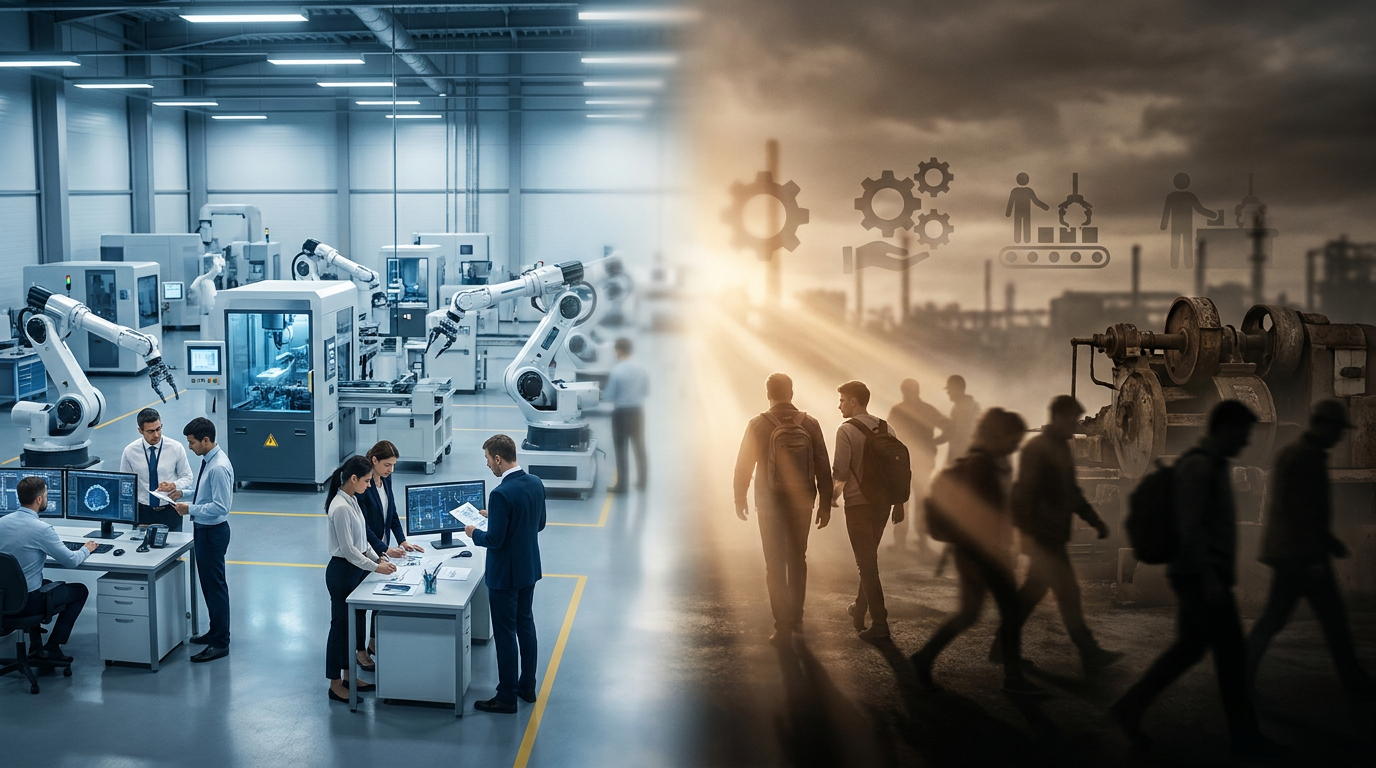

Jensen Huang pushes back against the industry’s most pessimistic predictions this week. The Nvidia CEO dismisses forecasts of mass unemployment and existential collapse as “ridiculous,” arguing that the current trajectory of artificial intelligence serves as a massive net positive for the global labor market.
- Jensen Huang characterizes existential AI doomsday prophecies as "ridiculous" during a recent Memos to the President podcast interview.
- Nvidia identifies over 500,000 new AI-linked U.S. positions created while committing half a trillion dollars to domestic infrastructure.
- The tech industry expects widespread robotic automation within five years to remove labor drudgery from global manufacturing and drug discovery.
The Case Against the ‘God Complex’
Huang appeared on the Memos to the President podcast released Thursday. The executive aimed his criticism at high-profile peers who characterized the technology as a 20 percent existential threat to humanity. He argued that these warnings often stem from a “god complex” prevalent among leaders at the top of the industry. He advocated for a debate grounded in labor data rather than speculative doomsday scenarios.
“Scaring people with nonsensical things, which are not going to happen—that this is an existential threat, that there’s a 20% chance that it destroys democracy—that’s ridiculous,” Huang said. “These kinds of comments remain unhelpful.”
Huang countered the pessimism with hard labor market data. He cited over 500,000 new positions created within the U.S. workforce linked to artificial intelligence over the last two years. Companies adopting the technology grew faster and expanded their staff counts as a result. He framed the push toward automated infrastructure as a vital chance for the United States to bring manufacturing jobs back to domestic soil.
Mechanical Tasks versus Professional Purpose
Huang differentiated between the mechanical components of a role and the deeper purpose of a career. Software engineering served as his primary case study. While artificial intelligence handled routine coding, the human professional performed the actual innovation.
Genuine News Deserves Honest Attention.
High-conviction projects require an intelligent audience. Connect with readers who value sharp reporting.
👉 Submit Your PR“The purpose of the job is to innovate, solve problems, connect with collaborators, find problems that exist, and solve them,” Huang observed. “You connect unrelated things and create something new. That remains the purpose of software engineering.”
He revisited his long-standing argument regarding radiologists to illustrate this dynamic. Analysts once predicted that superhuman image recognition would render the field obsolete. Hospitals instead utilized the software to process higher patient volumes, which improved clinical outcomes and increased revenue. Demand for human radiologists grew because the role transitioned from pure image reading to complex diagnosis and patient care.
Manufacturing Infrastructure and Future Reindustrialization
Nvidia committed to building half a trillion dollars of artificial intelligence infrastructure within the United States. This investment included chip fabrication plants, advanced packaging facilities, and supercomputer manufacturing hubs. Huang described the strategy as the bedrock for America’s industrial renewal, aimed at creating high-skilled labor positions that remained sustainable over the long term.
He anticipated that robots capable of performing physical tasks would see widespread adoption within three to five years. The primary benefit of this automation focused on the removal of drudgery, allowing the labor force to concentrate on high-value domains like drug discovery and advanced hardware production.
Chain Street’s Take
Huang runs the factory of the AI age, so his incentives remain clear. He needs engineers, and he needs the market to keep buying the dream of a frictionless transition.
His distinction between “task” and “purpose” provides a practical framework for anyone facing a changing job market. The 500,000-job figure tracks the expansion of the AI stack, but the broader labor shift remains more complex.
History proves that net employment increases after major shocks, yet the pain of displacement hits before new roles mature. Calling out hyperbole is fair. Pretending the transition remains painless for every worker is not. The path forward relies on accelerating adaptation so the new opportunities eventually outpace the old ones.
Activate Intelligence Layer
Institutional-grade structural analysis for this article.