


Global-e, the e-commerce partner for Ledger, notified customers on Monday of a data breach involving its cloud systems. The notification confirms that unauthorized actors accessed personal data including names and contact information. The leak marks a renewed privacy threat for owners of Ledger hardware wallets, many of whom have faced similar supply chain vulnerabilities in the past.
- The Breach: Global-e, the e-commerce partner for Ledger, confirmed unauthorized access to its cloud systems, exposing customer names and contact information but leaving payment data secure.
- The Safety: The incident is strictly limited to the third-party logistics provider; Ledger hardware devices, private keys, and the Ledger Live application remain unaffected.
- The Risk: Security experts warn that while funds are safe, the leak provides fuel for sophisticated phishing campaigns, similar to the harassment waves following the 2020 Shopify breach.
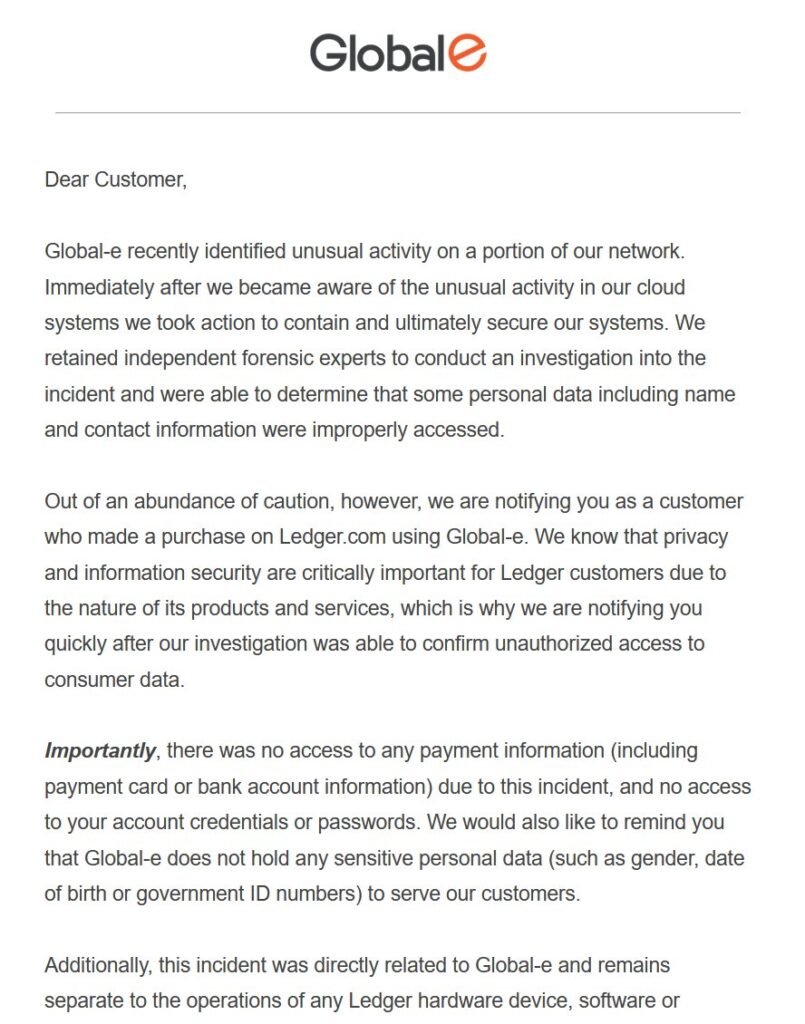
The email from Global-e stated the company identified unusual activity on a portion of its network. Immediately after identifying the activity, the firm took action to secure its systems and retained independent forensic experts to conduct an investigation. The investigation confirmed that some customer data was improperly accessed during the incident.
Ledger Financial, Hardware Data Remain Isolated
The breach appears limited to contact meta-data. Global-e specified in its notification that there was no access to payment information, including credit card or bank account details.
The attacker also failed to access account credentials or passwords. Global-e noted the firm does not hold sensitive personal data such as government ID numbers or dates of birth.
The incident relates strictly to the Global-e network and remains separate from Ledger’s own operations. Ledger hardware devices, the Ledger Live application, and Ledger’s internal systems were not affected by the breach.
Genuine News Deserves Honest Attention.
High-conviction projects require an intelligent audience. Connect with readers who value sharp reporting.
👉 Submit Your PRAccessing a user’s cryptocurrency assets still requires physical possession of the device and knowledge of the 24-word recovery phrase.
The Risks of ‘Merchant of Record’ Data
Global-e serves as the Merchant of Record for Ledger, handling checkout and international compliance for the hardware manufacturer. This role requires storing customer order data to manage taxes and shipping logistics.
Global-e provides similar services for several global brands, including Disney, Adidas, and Ralph Lauren.
The exposure of contact details provides sufficient information for sophisticated phishing campaigns. Attackers often use real names and order histories to craft convincing messages that trick users into revealing sensitive information.
Security investigator ZachXBT alerted the community to the emails on Monday as Ledger customers began receiving the notifications.
Ledger Historical Privacy Wounds
The leak reopens old wounds for the Ledger community. A massive 2020 data breach involving Shopify exposed the personal information of roughly 272,000 customers.
That event led to years of targeted harassment, including SIM swapping and physical threats. Security experts warn the Global-e breach could fuel a new cycle of social engineering.
By knowing who purchased hardware security devices, bad actors can target the human owners rather than the devices themselves. Social engineering remains the most successful way to bypass cold storage security.
Chain Street’s Take
The Global-e email confirms the “Swiss Cheese” paradox of crypto security. You buy a Ledger to become your own bank.
To get it delivered, you have to doxx yourself to a logistics firm that stores your data in a hot cloud. Your private keys are safe in cold storage, but your name and address now live in a hacker’s database.
This isn’t a Ledger hardware failure. It’s a fundamental supply chain failure. Self-custody will always carry a self-doxxing tax until hardware wallets can be bought anonymously over the counter.
If you received this email, your device is safe, but your inbox is now a target. Stay paranoid.
Activate Intelligence Layer
Institutional-grade structural analysis for this article.