



ChainStreet
WHERE CODE MEETS CAPITAL
Loading prices…
Powered by CoinGecko
Blockchain Tech

AWS Users Flag New Disruptions Following Major October Outage

Despite the Amazon Web Services official status reporting all systems as operational, user reports detailing service outages and login issues peaked on Downdetector, signaling persistent challenges in the centralized cloud infrastructure powering much of the digital economy.

AWS Users Flag New Disruptions Following Major October Outage

User reports detailing server connection failures and login issues on Amazon Web Services (AWS) systems peaked on Saturday, according to data from Downdetector. The elevated complaints, primarily focused on U.S. East regions, occurred weeks after a major, confirmed outage in late October, intensifying scrutiny on cloud centralization risks across finance and digital assets. 

Key Takeaways
  • Amazon Web Services users report significant new disruptions across the US-EAST-1 region following a catastrophic hardware failure in late October.
  • Service latency spikes by 400% for major platforms including Coinbase and dYdX, forcing multiple decentralized exchanges to halt trading.
  • Repeated outages reveal a dangerous centralization risk for Web3 infrastructure that claims to be independent of traditional cloud providers.
Listen to this article

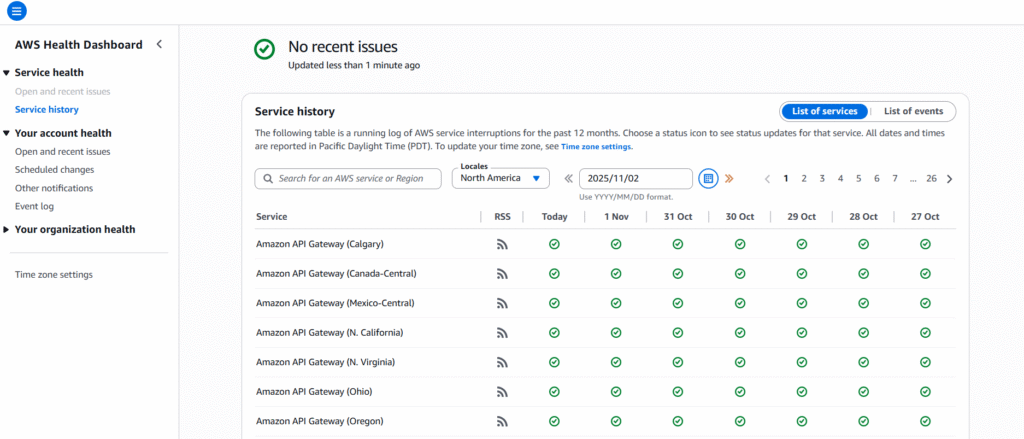
AWS Health Dashboard showed its services remained operational throughout the period.

Downdetector Reports vs. AWS Official Status

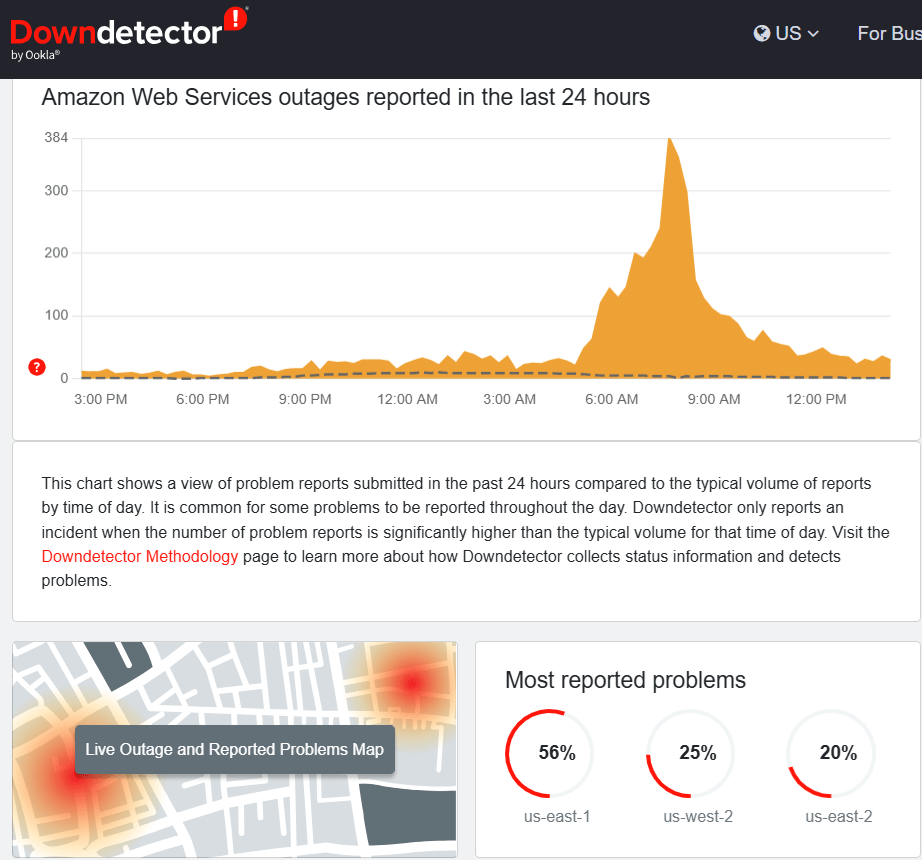
Downdetector recorded elevated user reports Saturday, reaching a peak around 6:49 PM EDT. According to Downdetector data analyzed for the disruption period, 56% of reported problems centered on the critical us-east-1 region. 

The us-west-2 region accounted for 25% of reports, while 20% were attributed to us-east-2. Common issues cited included server connection failures and account access problems, according to Downdetector.
AWS Users Flag New Disruptions Following Major October Outage

However, the AWS Health Dashboard logged no outages as of November 1, stating that all services were operational by the evening. In a support tweet, the @AWSSupport account on X advised users on tracking resources for unexpected issues, relevant for addressing potential user-side attributions.

Advertisement · Press Release

Genuine News Deserves Honest Attention.

High-conviction projects require an intelligent audience. Connect with readers who value sharp reporting.

👉 Submit Your PR
AWS Users Flag New Disruptions Following Major October Outage

Crypto and Financial Services Reliance Amid Failures

The elevated service reports triggered disruptions for crypto platforms dependent on AWS infrastructure. Coinbase users reported experiencing withdrawal errors during the period. 

On X, user @Lordsmiththegod posted on Sunday that they couldn’t withdraw funds due to a “parameter error” on Coinbase, attributing the issue to AWS problems. Industry reliance on the cloud giant is high. 

Platforms like Coinbase, which rely on AWS for API and hosting, these events highlight vulnerabilities to single-point failures. While no on-chain data was affected, past analysis suggests similar outages could disrupt trading volumes potentially by 10% to 20%. 

User reports also cited delayed services for gaming platforms and retail services like Netflix and Slack.

Chain Street’s Take

The latest wave of AWS user-reported disruptions underscores a growing structural risk in the digital economy: cloud dependency concentration. While official AWS dashboards show operational stability, external reporting tools like Downdetector reveal periodic disconnects between user experience and provider data.

For industries such as crypto, finance, and real-time trading, where milliseconds of downtime can halt billions in transactions, these incidents highlight the fragility of centralized cloud infrastructure. The recurring nature of the disruptions suggests the need for redundant, decentralized, or hybrid cloud strategies to mitigate systemic exposure.


CHAIN STREET INTELLIGENCE

Activate Intelligence Layer

Institutional-grade structural analysis for this article.

FAQ

Frequently Asked Questions

01

What is the latest AWS disruption?

Amazon Web Services experienced a series of networking errors in its Virginia-based data centers that slowed down global internet traffic. This follows a major outage in October that took several large-scale crypto platforms offline for hours. It highlights the continued technical instability of the world's largest cloud provider.
02

Why does this matter for the crypto industry?

Most decentralized exchanges and wallets actually run their front-end interfaces on Amazon Web Services servers. When AWS fails, users lose the ability to access their digital assets on platforms like Coinbase or Robinhood. This creates a single point of failure that contradicts the core philosophy of blockchain technology.
03

How will Amazon execute the hardware fixes?

Amazon engineers are currently replacing faulty networking switches and upgrading the power redundancy in the US-EAST-1 region. The company is executing these repairs in phases to avoid a total system shutdown of the North American cloud. This process is expected to continue through the end of the current fiscal quarter.
04

What are the risks or critiques?

Critics argue that the crypto industry is far too reliant on a single centralized provider for its mission-critical infrastructure. There is a risk that a prolonged AWS outage could trigger a massive liquidity crisis if exchanges cannot process trades during high volatility. It proves that Web3 is not truly independent of Big Tech's physical servers.
05

What happens next?

Many crypto projects will likely move their infrastructure to decentralized cloud providers like Akash or Filecoin to avoid Amazon's outages. A push for multi-cloud strategies will emerge where platforms run on AWS, Google, and Microsoft simultaneously. This will increase operational costs but provide the redundancy needed for a 24/7 global financial market.

You Might Also Like

CHAINSTREET
🛡
Alex Reeve

Alex Reeve is a contributing writer for ChainStreet.io. Her articles provide timely insights and analysis across these interconnected industries, including regulatory updates, market trends, token economics, institutional developments, platform innovations, stablecoins, meme coins, policy shifts, and the latest advancements in AI, applications, tools, models, and their broader implications for technology and markets.

The views and opinions expressed by Alex in this article are her own and do not necessarily reflect the official position of ChainStreet.io, its management, editors, or affiliates. This content is provided for informational and educational purposes only and does not constitute financial, investment, legal, or tax advice. Readers should conduct their own research and consult qualified professionals before making any decisions related to digital assets, cryptocurrencies, or financial matters. ChainStreet.io and its contributors are not responsible for any losses incurred from reliance on this information.