


Researchers from Columbia University have developed a novel network-based algorithm estimating that wash trading on the Polymarket prediction market reached nearly 60% of its weekly volume in late 2024. Wash trading refers to the practice of a trader simultaneously buying and selling a security through colluding accounts without taking any net market position, solely to artificially inflate recorded volume. This activity is prohibited by law in the United States, including under the Commodity Exchange Act of 1936, because it distorts market signals and misleads investors.
- Columbia University researchers identify extensive wash trading on the Polymarket prediction platform beginning in July 2024.
- Artificial transaction volume peaked at 60 percent in December 2024 before stabilizing near 20 percent by October 2025.
- This manipulation distorts market credibility as traders exploit zero-fee stablecoin structures to game future token airdrop incentives.
Columbia Researchers Analyze Polymarket Wash Trading
A Columbia University study estimates that 24.2% of Polymarket’s historical volume, representing $15.5 billion in dollar volume, is consistent with wash trading. The activity peaked at nearly 60% in December 2024, driven by the motive to artificially inflate trading metrics. The novel detection method tracks wallets that repeatedly open and close positions with colluding counterparties.
The team, including Allen Sirolly, Hongyao Ma, Yash Kanoria, and Rajiv Sethi, analyzed every trade on Polymarket from November 2022 through October 2025, covering $15.5 billion in reported volume. The algorithm flagged “approximately closed clusters of colluding counterparties” as indicative of wash trades, highlighting the scale of manipulation in crypto prediction markets.
“Wash trading artificially inflates trading metrics and distorts market signals,” the paper notes. “This affects both user perception and the platform’s reported growth.”
Peaks and Market-Specific Patterns in Polymarket Wash Trading
The Columbia study found that Polymarket wash trading surged in late 2024. Weekly wash volume reached nearly 60% in December 2024, dropped below 5% by May 2025, and rose again to about 20% by October 2025.
Genuine News Deserves Honest Attention.
High-conviction projects require an intelligent audience. Connect with readers who value sharp reporting.
👉 Submit Your PR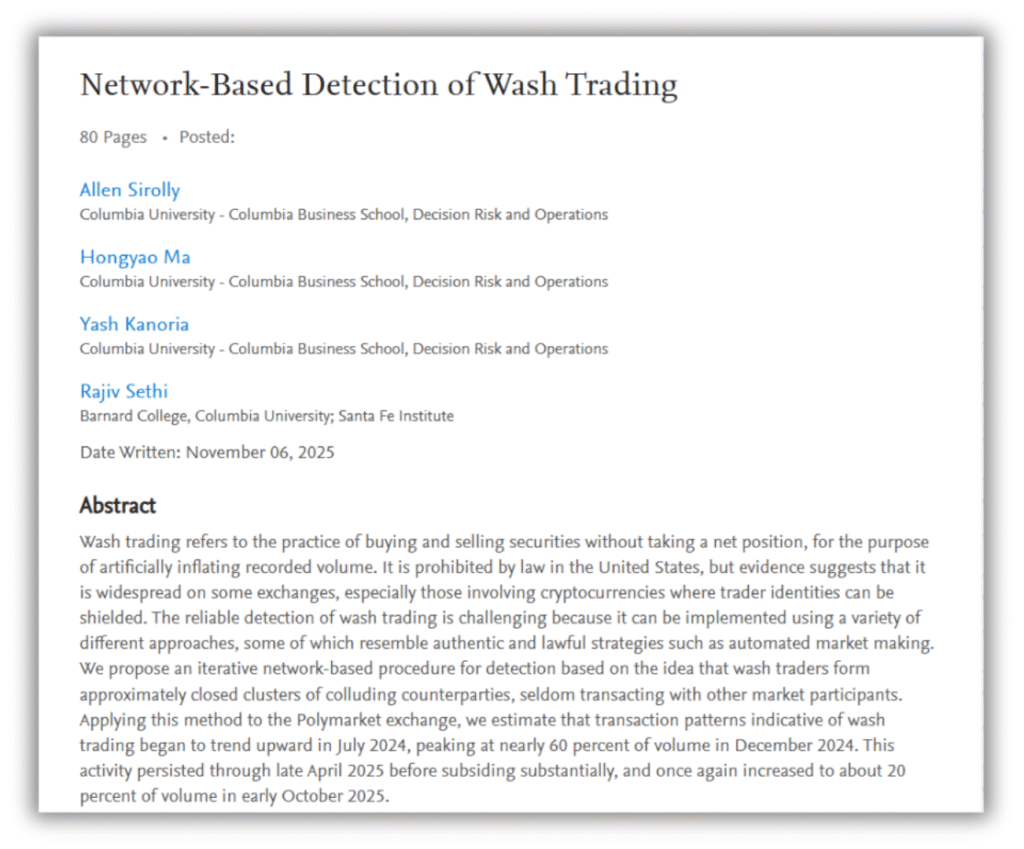
The prevalence of wash trading varied by market type. Sports markets were most affected, with 45% of all-time volume flagged, while election markets registered 17%, and crypto markets just 3%. These differences suggest that specific market categories and user incentives influenced the intensity of wash trading.
Airdrop Farming and Incentives Driving Polymarket Wash Trading
Researchers link the spike in Polymarket wash trading to airdrop farming ahead of Polymarket’s token launch, confirmed by the platform in October 2025. The absence of Know-Your-Customer (KYC) checks and zero transaction fees allowed users to trade anonymously across multiple wallets.
By inflating their trading volume, users sought larger allocations of the upcoming token. “Wash traders artificially boost volume to gain financial advantage in future airdrop distributions,” the study explains, noting that volume is often treated as a key metric of market participation.
Implications for Crypto Prediction Market Integrity
The findings underscore the broader risks of Polymarket wash trading for prediction markets that rely on trading volume as a signal of legitimacy and consensus. Artificial activity distorts price signals and misleads participants about actual engagement.
Sethi and colleagues emphasize the importance of robust detection mechanisms. Accurate metrics are essential to maintaining trust in platform-reported activity, ensuring that growth and user engagement reflect real participation rather than artificially inflated trades.
Chain Street’s Take
Polymarket’s numbers show that volume isn’t always what it seems. When incentives like airdrops drive behavior, reported activity can be misleading. Traders and analysts should focus on genuine, risk-bearing trades rather than headline figures.
Activate Intelligence Layer
Institutional-grade structural analysis for this article.