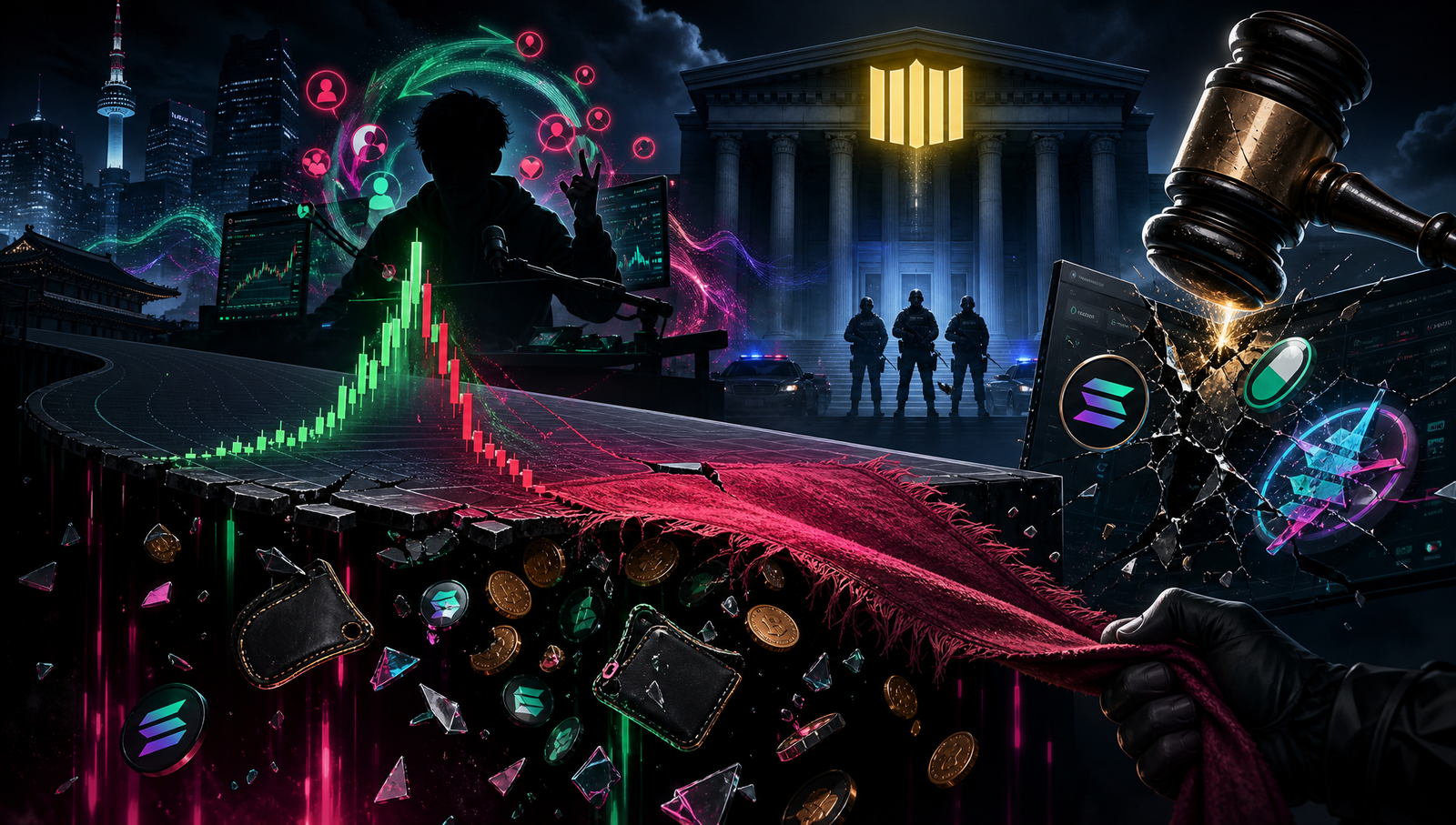

South Korean authorities file the nation’s first fraudulent trading charges against a decentralized exchange (DEX) scam ring today. The case targets a Solana-based meme coin operation that allegedly wiped out nearly $1 million in retail capital, signaling a new era of enforcement for permissionless blockchain platforms.
- Seoul Southern District Prosecutors indict "EtherFather" for orchestrating a one-million-dollar CATFI memecoin rug pull on the Solana network.
- The CATFI scam ring generates 400 million KRW in illicit profits from 256 victims following a record-breaking 1,000x price surge.
- South Korea applies the Virtual Asset User Protection Act to decentralized exchanges for the first time, ending the era of DEX immunity.
The Seoul Southern District Prosecutors’ Office announced the indictment of a group behind the CATFI token on May 27, 2026. The Joint Investigation Department for Virtual Asset Crimes focused on a lead suspect identified as Park, who managed the social media persona “EtherFather.” Park reportedly posed as an independent influencer to market CATFI following its issuance on the Pump.Fun platform in early 2025.
Investigators found that the group utilized false announcements and artificially inflated follower counts to create the illusion of organic demand. Circular trading obscured the group’s control over the circulating supply. Illicit profits from the operation reached approximately 400 million KRW, or roughly $260,000. The group achieved these returns from an initial investment of 10 million KRW. Approximately 256 investors reported total losses of 900 million KRW after the token price surged 1,000-fold in 26 hours before the project developers removed liquidity and vanished.
The prosecution represented the first instance of law enforcement applying fraudulent trading charges under the Virtual Asset User Protection Act. Previous cases in the region typically relied on simpler market manipulation or fraud statutes. The act, which became law in 2025, specifically prohibited the use of “fraudulent means, plans, or techniques” and the entry of false representations regarding material facts in digital asset trading.
Scammers issued CATFI on the Pump.Fun launchpad before listing the asset on a decentralized exchange. They deployed coordinated social media campaigns to generate buying pressure. Once the price peaked, the group liquidated their positions and deleted the project infrastructure. Prosecutors confirmed that the suspects distributed tokens across hundreds of wallets to hide the issuing entity’s identity from blockchain forensic tools.
Genuine News Deserves Honest Attention.
High-conviction projects require an intelligent audience. Connect with readers who value sharp reporting.
👉 Submit Your PRThe Joint Investigation Department emphasized a commitment to aggressive enforcement. “Based on legal expertise in the field of digital asset crimes, we will resolutely deal with acts that disrupt the digital asset market and undermine public trust,” the prosecution said.
Enforcement trends in South Korea shifted toward proactive infrastructure targeting following the rise of automated token launchpads. Barriers to entry for token issuance remained minimal on such platforms, creating new risks for individual investors. The indictment closed a previous loophole where decentralized environments sat outside the reach of traditional financial regulations. Analysts noted that the case provided a blueprint for how the Seoul Southern District intended to handle “rug pulls” on non-custodial networks.
Chain Street’s Take
The CATFI prosecution confirms that the era of “code is law” offers no immunity against the South Korean legal system. Prosecutors are using the 2025 Act to bridge the gap between anonymous on-chain activity and real-world criminal liability. If this indictment results in a conviction, it sets a global precedent for how governments can police permissionless platforms like Pump.Fun without needing a central entity to subpoena. For the Solana ecosystem, this is a signal that the “wild west” of memecoins is entering a phase of high-stakes legal scrutiny where social engineering is now treated as a felony.
Activate Intelligence Layer
Institutional-grade structural analysis for this article.