

Xinbi Guarantee captures nearly 100 percent of the illicit crypto guarantee market as rivals Huione and Tudou collapse under international enforcement pressure. The platform currently processes over $1.2 billion in USDT monthly inflows: a near-monopoly in a shadow ecosystem used to facilitate money laundering and cybercrime settlements.
- Xinbi Guarantee captures a near-monopoly of the illicit crypto guarantee market as rivals Huione and Tudou collapse under federal enforcement.
- The shadow platform processes over $1.2 billion in monthly USDT inflows and $24.2 billion in total transaction volume since 2022.
- Internalized messaging via SafeW allows Xinbi to bypass traditional blockchain monitoring while facilitating global money laundering and cybercrime settlements.
TRM Labs and Bitrace documented the operational shift in reports released earlier in 2026. The collapse of major competitors under sustained regulatory pressure created a vacuum that Xinbi filled through aggressive infrastructure migration. Huione Guarantee and its successor Tudou faced intense scrutiny starting in May 2025. The Financial Crimes Enforcement Network (FinCEN) issued a Section 311 designation at that time, which identified the networks as primary money laundering concerns. Telegram subsequently banned associated communication channels. The arrest of Prince Group chairman Chen Zhi in January 2026 accelerated the total decline of the Huione ecosystem. Tudou’s activity dropped by approximately 74 percent. Huione-linked services saw transaction volumes fall nearly 100 percent.
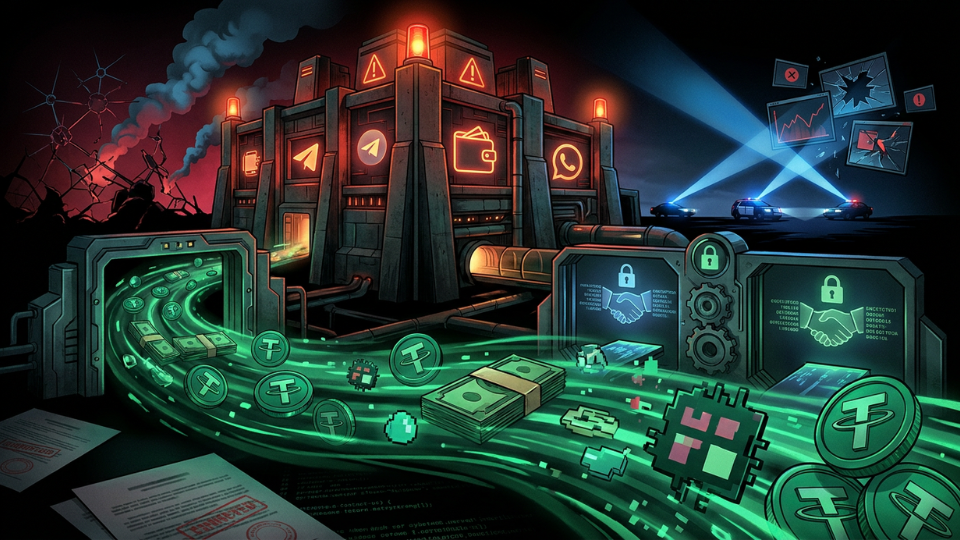
Xinbi demonstrated remarkable adaptability during the crackdown on its competitors. Management migrated users to a proprietary messaging app called SafeW and a wallet system known as XinbiPay. TRM Labs data showed that Xinbi processed approximately $24.2 billion in total transaction volume since 2022. Inflows reaching $12.1 billion occurred after May 2025. The platform functioned as an escrow hub for illicit services. It connected vendors and buyers while providing credit assurance through mandatory security deposits.
Bitrace analysts noted that Xinbi’s public groups covered every stage of the illicit supply chain. The groups included upstream technical services and downstream money laundering or cash-out operations. The closed-loop ecosystem internalized financial flows and reduced visibility to external blockchain monitoring tools.
The UK government sanctioned the platform on March 26, 2026. Resilient networks continued to operate despite the direct target of enforcement. TRM Labs reported that the service maintained operations by leveraging its internalized payment infrastructure. The consolidation of illicit liquidity into a single platform raised concerns about concentrated risk in underground financial infrastructure. Bitrace warned that as one operator absorbed the majority of shadow market liquidity, it became an even higher-priority target for global law enforcement task forces.
Genuine News Deserves Honest Attention.
High-conviction projects require an intelligent audience. Connect with readers who value sharp reporting.
👉 Submit Your PRThe emergence of a near-monopoly in the guarantee space highlighted the challenges regulators face in dismantling adaptable criminal networks. Xinbi’s success resulted from a strategy of internalized messaging and proprietary payment rails. The platform reduced the friction for cybercriminals by providing a centralized, trusted environment for high-risk settlements. Law enforcement agencies monitored the platform’s transition to the SafeW app as part of ongoing investigations into regional scam operations.
Chain Street’s Take
The rise of Xinbi Guarantee to near-monopoly status proves that enforcement pressure often reshapes rather than eliminates illicit financial networks. Crackdowns on Huione and Tudou concentrated power in a single, more adaptable operator instead of fragmenting the market. This consolidation makes future disruption more impactful but also underscores the persistent demand for escrow services in the crypto ecosystem. Regulators are no longer fighting scattered groups but a centralized shadow bank that has successfully internalized its most vulnerable communication and payment data.
Activate Intelligence Layer
Institutional-grade structural analysis for this article.