
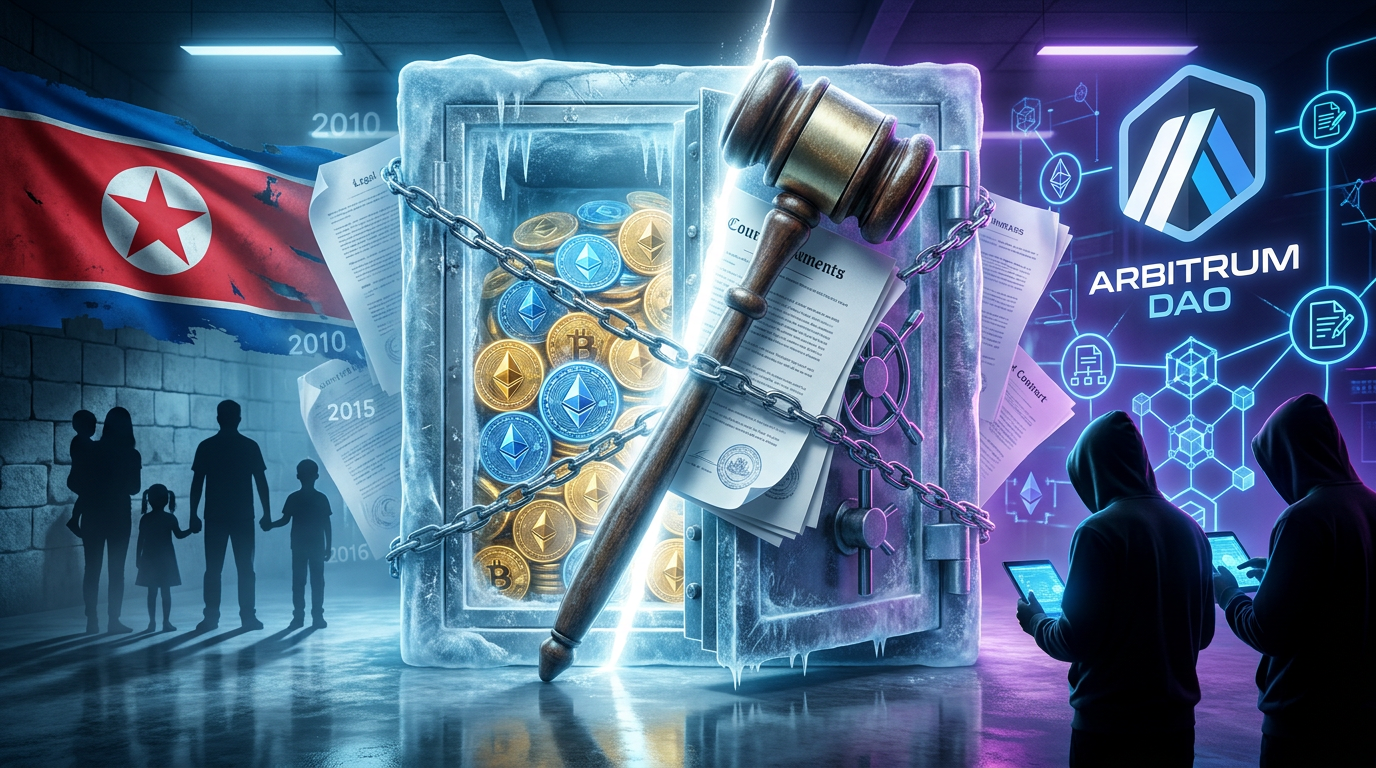

A New York federal court halts the Arbitrum DAO from releasing approximately 30,766 ETH, currently valued at $71 million. The assets remain locked following the April 2026 KelpDAO exploit. Gerstein Harrow LLP secured a restraining notice and three writs of execution on April 30. The firm served the order directly on the DAO through its official governance forum the following day.
- The Southern District of New York halts Arbitrum DAO from releasing $71 million in ETH recovered from the KelpDAO exploit.
- Gerstein Harrow LLP serves a restraining notice to satisfy $877 million in unpaid terrorism judgments against the Lazarus Group.
- KelpDAO victims face extended delays as traditional legal claims over on-chain assets supersede the speed of decentralized governance votes.
The Legal Strategy
Charlie Gerstein of Gerstein Harrow LLP posted a notice on the Arbitrum forum. “The United States District Court for the Southern District of New York authorized me to serve on Arbitrum DAO a restraining notice and three writs of execution,” Gerstein stated.
The firm represents clients who hold more than $877 million in unpaid default judgments against North Korea. Those judgments stemmed from terrorism-related cases decided in 2010, 2015, and 2016. Attorneys argued that the frozen ETH qualified as property linked to the Democratic People’s Republic of Korea (DPRK) because blockchain analysis tied the KelpDAO exploit to the state-sponsored Lazarus Group.
Asset Freeze and Governance Deadlock
Arbitrum’s Security Council froze the 30,766 ETH shortly after the $292 million hack and moved the funds to a controlled address. The DAO prepared governance proposals to return the assets to KelpDAO victims, including rsETH holders who lost liquidity in the attack. Those recovery proposals currently face a mandatory pause while the legal process unfolds.
Gerstein Harrow previously pursued crypto assets linked to Lazarus Group operations to satisfy existing judgments. The legal team treated traceable on-chain assets as reachable property under U.S. court authority, even when those assets resided inside decentralized protocols.
Genuine News Deserves Honest Attention.
High-conviction projects require an intelligent audience. Connect with readers who value sharp reporting.
👉 Submit Your PRStructural Conflict in Digital Finance
KelpDAO participants who lost funds just weeks ago now face extended delays. Many users expected a fast, on-chain remediation process typical in DeFi exploits. The federal court order took precedence, forcing participants to wait while the judiciary determined priority between recent victims and families who won judgments against North Korea years earlier.
The situation highlighted a tension in crypto governance. Decentralized projects functioned as quasi-custodians that attempted to return stolen funds quickly through governance votes, but traditional legal processes superseded those efforts once federal courts intervened. Arbitrum operated as one of the largest Layer-2 networks with significant total value locked. The case tested how decentralized autonomous organizations interacted with real-world jurisdiction, as courts served them through public governance channels like forum posts.
Chain Street’s Take
The KelpDAO exploit proves that DeFi struggles with the friction of sovereign law. People who lost money in the April hack now sit behind families who secured court victories against North Korea over a decade ago. Both groups suffered losses to the same state actor, but the timeline creates a brutal queue.
Gerstein Harrow executed a previously tested legal maneuver. From a pure legal standpoint, the argument checks out. From a human standpoint, the reality feels deeply unfair to recent victims who assumed decentralized finance moved faster than traditional banking. We are watching a collision between two worlds. DeFi tries to return funds at the speed of code. U.S. courts enforce judgments at the pace of paper filings. The Ethereum remains locked in the middle while both systems determine priority. Expect this pattern to repeat as stolen crypto volumes grow. The money remains traceable, but justice moves at a pace that is complicated, slow, and increasingly contested.
Activate Intelligence Layer
Institutional-grade structural analysis for this article.