



CME Group Inc. is currently halting all trading on its Globex electronic platform, effectively freezing regulated Bitcoin and Ether futures due to a critical cooling failure at a CyrusOne data center. The outage creates an immediate liquidity vacuum for institutional investors, severing the primary hedging mechanism between Wall Street and the digital asset economy during a period of extreme market fragility.
- Institutional Freeze: CME Group has halted trading on its Globex platform due to a CyrusOne data center cooling issue, locking institutions out of Bitcoin (BTC) and Ether (ETH) futures.
- Hedging Disruption: The outage interrupts a period of record volume for crypto derivatives, leaving traders unable to hedge positions amid a 20% market drawdown.
- Volatility Catalyst: Analysts warn that the disconnect between frozen futures and active spot markets creates "gap risk," threatening violent price action once connections are restored.
Data Center Failure Severs the Institutional Link
The disruption, which began early Friday, has paralyzed the world’s largest derivatives exchange. While the halt affects all asset classes, the impact on the crypto sector is uniquely severe due to the reliance of ETFs and hedge funds on CME futures for price discovery.
“Due to a cooling issue at CyrusOne data centers, our markets are currently halted,” CME Group confirmed in an official statement on X and its website. “Support is working to resolve the issue in the near term and will advise clients of Pre-Open details as soon as they are available.”
As of press time, the Globex platform remains offline. This leaves institutional desks unable to execute orders, stranding billions in exposure while spot markets on unregulated exchanges like Binance and Coinbase continue to trade 24/7.
Why the CME Group Outage Amplifies Volatility Fears
The timing of the infrastructure failure has compounded fears of systemic risk. The outage arrives at the tail end of a turbulent November for digital assets, marked by a market-wide correction exceeding 20% and the Crypto Fear & Greed Index plunging to “Extreme Fear” lows between 11 and 24.
Genuine News Deserves Honest Attention.
High-conviction projects require an intelligent audience. Connect with readers who value sharp reporting.
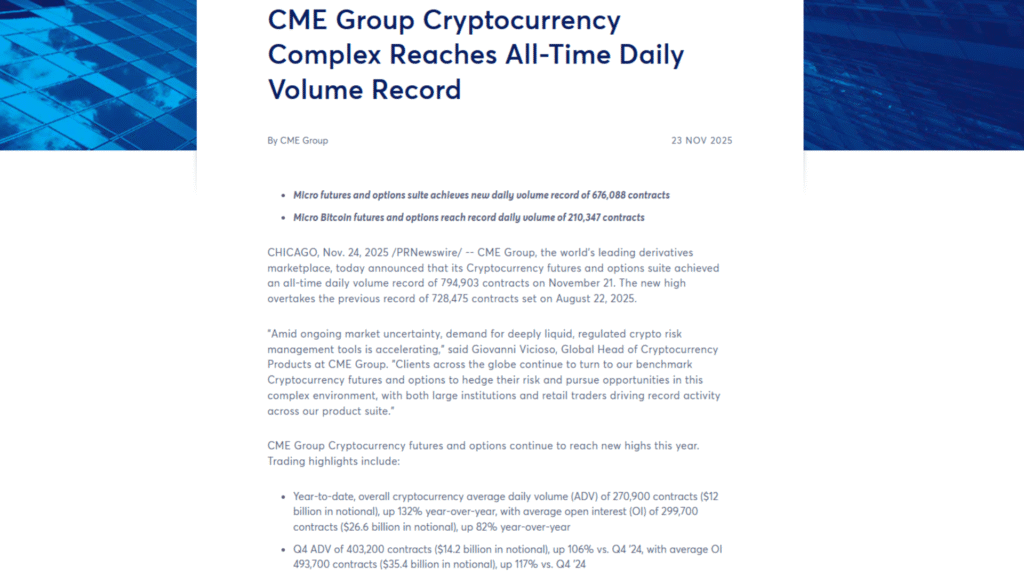
👉 Submit Your PRJust days prior to the crash, CME reported record-breaking crypto futures volumes, including nearly 795,000 contracts traded on November 21, signaling a massive demand for hedging against uncertainty. The sudden freeze interrupts this momentum, potentially forcing institutions to pull liquidity from the market.
Market analysts note that the halt disrupts the arbitrage loop that keeps futures prices aligned with spot prices. Without this tether, “gap risk” increases significantly.
When the exchange eventually reopens, algorithms will attempt to instantly reconcile the price difference between the frozen futures and the moving spot market, a scenario that frequently triggers violent volatility and “stop hunts.”
Systemic Fragility vs. Decentralized Trading
The event has reignited discussions regarding the fragility of centralized financial infrastructure. While the regulated “giants” remain dark due to a single point of failure at a data center, decentralized and spot crypto markets have continued uninterrupted.
However, this divergence presents its own risks. With institutional liquidity locked inside the CME, traders are forced to pivot to thinner spot markets to manage risk.
This capital rotation can exacerbate price swings, as order books on spot exchanges lack the depth to absorb institutional-sized flows without significant slippage.
CME GRoup: Pre-Open Protocol
CME Group has indicated it will provide a “Pre-Open” notification before trading resumes. This period is critical for allowing traders to adjust or cancel orders that were placed before the freeze, an essential step to preventing a flash crash upon the market’s restart.
Until then, the regulated crypto market remains in a state of suspended animation.
Chain Street’s Take
CME’s shutdown leaves the institutional crypto market flying blind, with hedges frozen and price discovery severed at the worst possible moment. The longer Globex stays dark, the sharper the futures-spot snapback is likely to be once trading returns.
Activate Intelligence Layer
Institutional-grade structural analysis for this article.